


Wall Street ended October on a difficult note as technology stocks came under heavy selling pressure. Disappointing quarterly results from Intel and Amazon intensified concerns about the enormous investments being made in artificial intelligence and raised questions about when those expenditures could translate into sustainable financial returns.
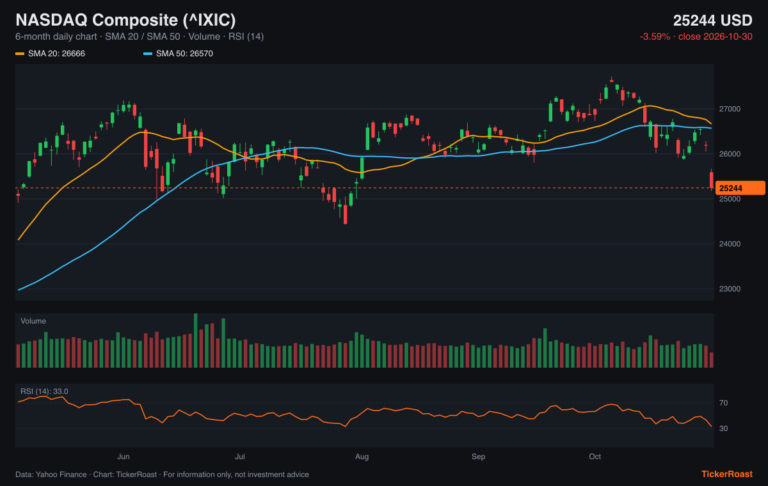
The Nasdaq Composite fell 2.86% on Friday, October 30, while the S&P 500 declined 1.82% and the Dow Jones Industrial Average lost 1.09%.
The sell-off highlighted a growing concern among investors: the rapid expansion of artificial intelligence may create significant business opportunities, but the financial cost of building the infrastructure behind it is becoming increasingly important.
Wall Street Today: Major U.S. Stock Indexes End Sharply Lower
All three major U.S. stock indexes finished Friday’s session in negative territory.
The Nasdaq recorded its largest one-day percentage decline since June, while the S&P 500 experienced its worst trading session since June.
The closing figures were:
| Index | Closing Level | Daily Change |
|---|---|---|
| Dow Jones Industrial Average | 51,770.31 | -1.09% |
| S&P 500 | 7,580.07 | -1.82% |
| Nasdaq Composite | 25,437.00 | -2.86% |
| Russell 2000 | 2,811.84 | -1.66% |
Technology and semiconductor stocks accounted for a significant part of the market weakness.
The decline also followed a difficult week for major technology companies, as investors reassessed earnings announcements and the financial implications of continued AI infrastructure spending.
Despite Friday’s losses, the major U.S. indexes remained positive for 2026.
Intel Stock Plunges Nearly 29% After Disappointing Outlook
Intel was among the biggest losers of Friday’s session.
The semiconductor company’s shares plunged approximately 28.6% after its latest quarterly results and forward guidance disappointed investors.
The reaction reflected concerns about the company’s near-term outlook and its ability to translate business improvements into stronger financial performance.
Intel’s decline also had broader implications for the semiconductor sector.
Chip manufacturers are central to the expansion of artificial intelligence infrastructure, as data centers require increasingly powerful processors and specialized computing equipment.
However, strong long-term demand for computing capacity does not automatically guarantee that every semiconductor company will benefit equally.
Investors are increasingly examining profitability, production costs, competitive positioning and future revenue expectations.
Intel’s sharp decline illustrated how quickly market sentiment can change when corporate performance falls short of expectations.
Amazon Earnings Put AI Spending and Cash Flow Under the Microscope
Amazon also attracted considerable attention following its latest quarterly results.
The company continues to invest heavily in cloud computing infrastructure, data centers and artificial intelligence capabilities.
These investments are intended to support future demand for cloud services and AI-related products. However, they also require substantial capital expenditure.
One important issue highlighted by Amazon’s results was free cash flow.
According to Yahoo Finance’s analysis of the company’s third-quarter figures, Amazon recorded a negative free cash flow of more than $42 billion over the preceding 12 months through September.
The figure reflects the substantial financial resources being committed to infrastructure and other investments.
Free cash flow is an important financial measure because it represents the cash remaining after a company accounts for capital expenditures.
Negative free cash flow does not necessarily indicate that a business is financially unhealthy. Companies can deliberately invest heavily in infrastructure when they expect those investments to support future growth.
However, investors need to assess whether the expected benefits justify the financial commitments.
For Amazon, the central question is how quickly its investments in artificial intelligence and cloud infrastructure can generate additional operating cash flow.
Why Artificial Intelligence Spending Is Becoming a Wall Street Concern
Artificial intelligence remains one of the most important technology developments of the decade.
Major technology companies are investing billions of dollars in data centers, advanced processors, networking equipment, energy infrastructure and AI software.
These investments are creating opportunities for semiconductor manufacturers, cloud providers, equipment suppliers and other businesses involved in the technology ecosystem.
However, the scale of spending is also increasing financial expectations.
Investors are no longer evaluating technology companies solely on their AI ambitions or projected demand. They are also examining how those investments affect earnings, margins, debt levels and free cash flow.
Building AI infrastructure is expensive, and generating revenue from that infrastructure may take time.
Companies must attract customers, develop commercially viable services and manage the operating costs associated with increasingly complex computing systems.
This creates a distinction between technological progress and financial performance.
The technology may continue to advance even as investors become more selective about which companies can convert that progress into sustainable profits.
Semiconductor Stocks Face Broad Selling Pressure
Friday’s decline extended beyond Intel.
Several major semiconductor and technology infrastructure companies also experienced significant losses.
According to Reuters, Nvidia shares fell approximately 4.2%, while AMD declined around 10.9%.
The broader semiconductor sector came under pressure as investors reassessed expectations surrounding AI-related demand and corporate spending.
The weakness was also visible among companies supplying servers and other data-center equipment.
This reaction highlights how interconnected the AI investment ecosystem has become.
A change in expectations for major cloud providers can affect semiconductor manufacturers, server producers, networking companies and other technology suppliers.
However, the performance of individual businesses will continue to depend on their own financial results, competitive positions and ability to meet customer demand.
October Ends With a More Selective Market
Friday’s sell-off also affected the monthly performance of major U.S. indexes.
According to Yahoo Finance, the Nasdaq Composite recorded its weakest monthly performance since March 2025, while the S&P 500 also ended October lower.
The Dow Jones Industrial Average, in contrast, remained positive for the month.
This divergence suggests that investors were not necessarily abandoning the entire stock market. Instead, selling pressure was particularly pronounced in parts of the technology sector.
Market performance can vary significantly between industries, even when broader economic conditions remain unchanged.
The recent developments also demonstrate the importance of corporate earnings expectations in determining stock valuations.
Companies associated with major technological trends can experience substantial share-price volatility when their financial results or guidance fail to match market expectations.
What Could Shape Wall Street in November?
Several factors could influence U.S. financial markets during November.
Corporate earnings: Investors will continue assessing quarterly results, revenue growth, profit margins and management forecasts.
Artificial intelligence investment: Spending plans from major technology companies will remain an important focus, particularly where capital expenditure is increasing faster than operating cash flow.
Inflation and employment: Upcoming U.S. economic reports could influence expectations about economic growth and Federal Reserve monetary policy.
Interest rates: The Federal Reserve’s policy decisions and communications will remain relevant to financial conditions and market valuations.
Technology valuations: Investors may continue distinguishing between companies with measurable AI-related revenue and those whose financial returns remain less certain.
The U.S. midterm elections scheduled for November 3 may also attract market attention as investors assess potential policy implications.
None of these factors guarantees a particular direction for stock prices. Their impact will depend on incoming data, corporate developments and changing market expectations.
Analysis: Wall Street Is Asking for Financial Returns, Not Just AI Ambitions
Friday’s market decline highlights an important distinction between technological innovation and investment profitability.
Artificial intelligence could create substantial commercial opportunities across multiple industries. However, companies investing heavily in this technology must eventually demonstrate that their expenditures can generate adequate financial returns.
Amazon’s cash flow figures illustrate the financial scale of building infrastructure for future growth.
Intel’s share-price reaction demonstrates how sensitive investors can be to disappointing guidance, particularly in a sector where expectations are high.
These developments do not establish that the AI boom is ending or that the industry’s long-term prospects have fundamentally changed.
They do, however, show that investors are paying closer attention to the financial consequences of the AI investment cycle.
For technology companies, demonstrating sustainable revenue growth, operating profitability and cash generation may become just as important as announcing new AI projects.
The distinction matters because a promising technology does not automatically make every company involved in its development a successful investment.
Conclusion: Big Tech Faces a New Test as AI Spending Accelerates
Wall Street ended October 30 with substantial losses as technology shares declined and investors questioned the financial returns associated with massive artificial intelligence investments.
The Nasdaq Composite fell 2.86%, the S&P 500 declined 1.82%, and the Dow Jones Industrial Average lost 1.09%.
Intel suffered a particularly sharp decline following disappointing guidance, while Amazon’s investment requirements and free cash flow attracted renewed scrutiny.
The latest developments do not necessarily signal the end of the artificial intelligence boom. Instead, they highlight a changing market environment in which investors are examining not only the potential of AI, but also the cost of developing and commercializing it.
As November begins, corporate earnings, capital expenditure plans and evidence of sustainable cash generation are likely to remain central themes for Wall Street.
Disclaimer: This article is for informational and educational purposes only. It does not constitute investment advice, financial advice, or a recommendation to buy, sell, or hold any financial instrument. The information presented is based on publicly available sources at the time of publication and may become outdated. Readers should conduct their own research and consult a qualified financial professional before making investment decisions.
Sources: Reuters, October 30, 2026; Associated Press, October 30, 2026; Yahoo Finance, October 30, 2026; publicly available corporate earnings information from Intel and Amazon.
Anonymous reader poll, just for fun. Not investment advice.
Read next

Get the daily market briefing
The stories that move markets, in your inbox every trading day at 9 a.m. ET. Free, unsubscribe anytime.