
October 30, 2026 | TickerRoast Markets Analysis
DoorDash agreed on Thursday to acquire Instacart for about $17 billion, bringing together DoorDash’s delivery network and Instacart’s grocery technology. It reported record orders and profit the same morning, and its shares rose 5.6%. The harder part comes next: a review by antitrust regulators that the companies expect to take until late 2027 or the first half of 2028.
$65 a Share, Mostly in Cash
According to the joint announcement, DoorDash will pay $65.00 for each Instacart share, an equity value of approximately $17 billion and a 26% premium to Instacart’s closing price on Oct. 22, the last trading day before media reports of a possible deal. Instacart holders can choose cash, DoorDash stock or a mix, but the stock component is capped at 25% of the total, so the deal is at least 75% cash. Instacart’s board approved the agreement unanimously, and holders of about 19% of its shares have agreed to vote in favor.
To fund the cash portion, DoorDash obtained a commitment from JPMorgan for a 364-day senior unsecured bridge loan of up to $13.0 billion, according to its 8-K filing. It expects to replace the bridge with cash on hand and permanent financing before closing and says it is targeting a capital structure that preserves investment-grade ratings.
Why DoorDash Wants Instacart
The strategic logic is about grocery. DoorDash says Instacart works with more than 2,200 retail banners representing nearly 100,000 stores, and that Instacart customers could gain access to more than 50,000 additional stores. DashPass and Instacart+ members would pay a single membership fee, saving them an estimated $100 million a year. DoorDash plans to keep the Instacart brand, its app and its enterprise technology products, which power grocers’ own websites and retail media networks.
In its third-quarter release, DoorDash says it sees a multi-year path to $500 million or more of annual synergies, net of investments. It also says it expects to reinvest more than 100% of those synergies in the first year after closing, with positive net synergies from year two. I read that as a deliberate signal to regulators and to Instacart’s grocery partners that the combined company plans to cut prices and fees rather than raise them, at least at first.
A Record Quarter Behind the Deal
The acquisition landed alongside a strong set of numbers. Total orders rose 28% to 993 million, Marketplace gross order value grew 36% to $33.9 billion and revenue increased 34% to $4.6 billion. Net income attributable to common stockholders rose 91% to $466 million and adjusted EBITDA increased 41% to $1.06 billion. Excluding Deliveroo, which DoorDash acquired a year ago, orders grew 17% and both gross order value and revenue grew 23%.
| Metric | Q3 2026 | Year-over-year change |
|---|---|---|
| Total orders | 993M | +28% (+17% ex-Deliveroo) |
| Marketplace GOV | $33.9B | +36% (+23% ex-Deliveroo) |
| Revenue | $4.6B | +34% (+23% ex-Deliveroo) |
| Net income to common stockholders | $466M | +91% |
| Adjusted EBITDA | $1,060M | +41% |
DoorDash notes that growth in its U.S. grocery and retail categories ran at more than double the pace of its U.S. restaurant business. For the fourth quarter, it guides Marketplace gross order value of $35.4 billion to $36.4 billion and adjusted EBITDA of $900 million to $1.1 billion.
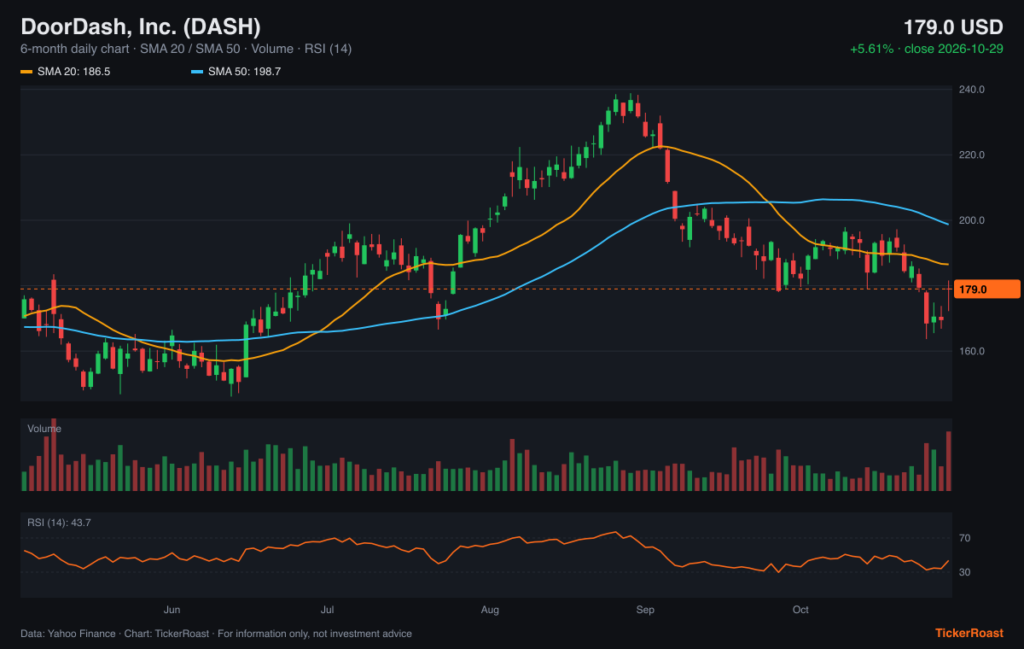
The chart shows DoorDash’s six months of trading through Thursday’s close at $179.00, up 5.61% on the day on the highest volume shown on the chart. The rebound followed a sharp drop in the previous week that took the stock toward $165. Even after Thursday’s gain, the shares remain below their 20-day average near $186.50 and their 50-day average near $198.70, far from the late-August peak near $238, with an RSI around 44.
The Antitrust Road Is Long
DoorDash closed Thursday 5.61% higher, according to Stock Titan, which suggests investors are comfortable with the price and the financing. The bigger uncertainty is regulatory. The deal requires clearance under the Hart-Scott-Rodino Act in the United States and approvals in Canada and Israel. The merger agreement gives the parties 12 months, with up to four automatic three-month extensions if only antitrust conditions remain, and the companies themselves expect closing at the end of 2027 or in the first half of 2028.
The termination fees show who carries the risk. Instacart would owe DoorDash $650 million in certain cases, such as accepting a superior proposal. DoorDash would owe Instacart $1.25 billion if the deal fails because of an antitrust block or because antitrust approvals are not obtained by the outside date. A reverse termination fee that size tells me DoorDash expects a serious review and is willing to pay for certainty on Instacart’s side.
The commitments DoorDash made on Thursday, including no grocery exclusivity and an open platform for local grocers, read like the opening arguments of that review. Whether they are enough will depend on how regulators define the market: as online grocery delivery, where the two companies are large, or as grocery retail broadly, where they compete with the biggest retailers’ own delivery fleets. Until that question is answered, Instacart shareholders are holding what is effectively a long-dated claim on $65 in cash.
Sources
- DoorDash to Acquire Instacart to Help Local Stores Win — DoorDash and Instacart (SEC filing)
- DoorDash Form 8-K: merger agreement and bridge commitment — DoorDash (SEC filing)
- DoorDash Releases Third Quarter 2026 Financial Results — DoorDash (SEC filing)
- Stock Market Today, October 29, 2026 — Stock Titan
Market data: Yahoo Finance, close of 2026-10-29. Charts generated by TickerRoast from this data.
Disclaimer: This article is for informational and educational purposes only. It provides general financial and business analysis and does not constitute investment advice, a personal recommendation, a recommendation to buy, sell or hold any security, or an offer to transact in any financial instrument. Information is based on publicly available sources as of October 30, 2026 and market data as of the 2026-10-29 close (Yahoo Finance). Past performance is not a reliable indicator of future results; forecasts are uncertain and actual results may differ materially. Investing in shares involves risk, including the loss of capital. The publisher does not guarantee the accuracy or completeness of the information and accepts no responsibility for investment decisions made on the basis of this article. Readers should consult official company disclosures, conduct their own research and, where appropriate, seek advice from a licensed financial adviser. Any relevant financial interests held by the author or publisher in the securities mentioned are disclosed where applicable. This article was prepared with the assistance of AI tools and is based on the sources listed above.
Anonymous reader poll, just for fun. Not investment advice.
Read next
Get the daily market briefing
The stories that move markets, in your inbox every trading day at 9 a.m. ET. Free, unsubscribe anytime.