
For decades, the global economy has largely operated on a simple principle: produce, consume and discard. Products are manufactured using raw materials, distributed to consumers, used for a limited period and eventually thrown away. This linear economic model has contributed to industrial growth, technological development and rising living standards. However, it has also created significant environmental and economic challenges.
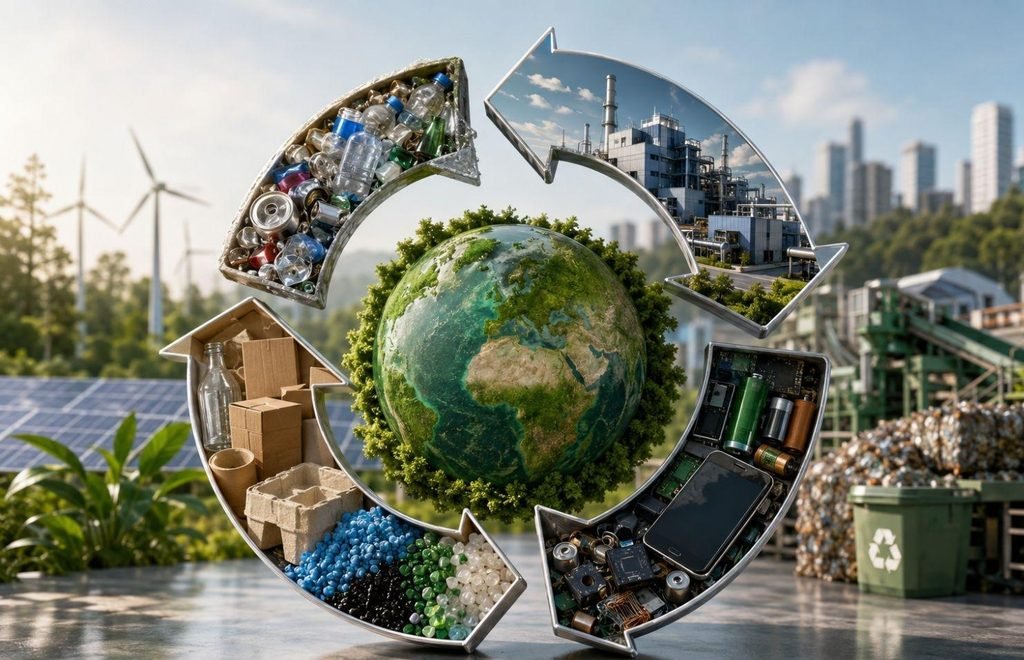
As natural resources become increasingly pressured, waste management costs rise and households look for ways to manage their spending, a different economic model is gaining attention: the circular economy.
Rather than treating products as disposable goods, the circular economy seeks to extend their useful lives through reuse, repair, refurbishment, redistribution and recycling. It challenges the traditional assumption that economic activity must always depend on the production and sale of new goods.
This transition is creating opportunities for businesses, consumers, digital platforms and local communities. From the growing second-hand market to free giving platforms that connect people with unwanted items, new forms of consumption are gradually changing how value is created and distributed.
France offers an interesting example of this transformation, with a rapidly developing second-hand economy and the emergence of digital initiatives such as Casert.fr, a platform dedicated to free giving between individuals.
What Is the Circular Economy?
The circular economy is an economic model designed to minimize waste and make better use of existing resources.
In a traditional linear economy, products generally follow three stages:
- Production using raw materials and energy.
- Consumption by individuals or businesses.
- Disposal when products are no longer needed.
The circular model introduces a different approach. Instead of allowing products to become waste as soon as their first owner stops using them, it encourages keeping materials and products in circulation for as long as possible.
This can happen through several complementary activities:
Reuse: Giving an existing product another life without fundamentally changing it.
Repair: Fixing damaged products instead of replacing them with new ones.
Refurbishment: Restoring used products to a functional condition, sometimes with improvements.
Resale: Transferring products to another consumer through second-hand markets.
Sharing and redistribution: Allowing products to be used by multiple people or transferred to individuals who need them.
Recycling: Recovering materials from products that can no longer be reused or repaired.
These activities are not economically identical. Reuse and repair generally preserve more of the original product’s value than recycling, which often requires additional processing and energy.
The objective is therefore not simply to recycle more waste. It is to prevent unnecessary waste from being created in the first place.
The circular economy also introduces an important economic question: why should society manufacture a new product when an existing one could still satisfy the same need?
The Economic Cost of the Traditional Consumption Model
Modern economies depend heavily on production and consumption. Manufacturing industries create employment, generate tax revenues, support international trade and stimulate investment.
However, producing new goods also requires significant quantities of resources.
Consider the lifecycle of an ordinary household product. Its production may involve extracting raw materials, processing components, transporting them across international supply chains, assembling the final product, packaging it and distributing it to retailers.
Each stage consumes resources and generates costs.
When a consumer replaces a functional product simply because they no longer need it, much of the economic value embedded in that product may be lost.
A functioning television, a table, a child’s bicycle or a household appliance can still provide value even if its original owner has no further use for it.
From an economic perspective, this creates an opportunity to redistribute existing assets rather than constantly relying on new production.
The challenge is organizational: people need accessible ways to find someone who can use what they no longer need.
Digital marketplaces and community-based platforms are increasingly helping solve this problem.
The Growth of the Second-Hand Economy
The expansion of second-hand markets is one of the most visible signs of the transition toward more circular consumption.
For many years, buying used products was sometimes associated with financial limitations or a lack of alternatives. Today, the perception is changing.
Consumers increasingly consider second-hand products for practical, financial and environmental reasons.
Clothing, electronics, furniture, books, toys and household equipment are among the categories where resale and reuse have become more established.
France provides a particularly interesting example.
According to France’s Directorate General for Enterprises (Direction générale des Entreprises), the French second-hand market was estimated at approximately €14 billion in 2024, excluding automobiles.
This illustrates the growing economic importance of extending the useful life of consumer products.
The second-hand market is no longer simply an informal activity between individuals. It has become an important part of the broader retail and digital economy.
Specialized platforms, professional refurbishers, retailers and individual sellers are creating new commercial opportunities around products that have already been purchased once.
However, resale represents only one part of the circular economy.
Another model deserves attention: giving products away for free.
Beyond Second-Hand Sales: The Economic Value of Free Giving
Not every useful product needs to be sold.
In many households, perfectly functional items are no longer needed because their owners have moved, upgraded their equipment, changed their lifestyles or simply purchased something different.
These products often remain unused in storage rooms, garages and cupboards. In some cases, they are eventually discarded despite being in good condition.
Free giving offers an alternative.
Instead of selling an unwanted item, its owner can transfer it directly to another person who needs it.
This model creates value in a different way from traditional commercial transactions.
There is no purchase price, no resale margin and potentially no need for an intermediary to own the product. The main objective is to facilitate the transfer of an existing resource from someone who no longer needs it to someone who can use it.
The economic benefits can be meaningful:
For the original owner: Giving an item away can be easier than organizing a sale, negotiating a price or finding a buyer.
For the recipient: Access to a free product can reduce household expenses and provide an affordable solution to an everyday need.
For society: Extending the useful life of products can reduce premature disposal and the demand for replacement goods.
For the environment: Reusing an existing product may avoid some of the environmental impacts associated with manufacturing and distributing a replacement.
Free giving is particularly relevant for furniture, clothing, children’s equipment, books, toys and household appliances.
It also demonstrates that economic value is not always measured by the amount of money exchanged.
A product can have little or no resale value for its owner while remaining highly useful to another household.
How Digital Platforms Are Transforming Product Reuse
One of the biggest obstacles to reuse has historically been the difficulty of connecting people.
Someone might have a perfectly usable desk that they want to give away, while another person living a few kilometers away is looking for inexpensive furniture.
Without an efficient communication system, these two individuals may never discover each other.
Digital platforms reduce this friction.
Online marketplaces, classified advertisement websites and community platforms make it easier to publish listings, discover available products and communicate with other individuals.
Their economic contribution is not necessarily based on manufacturing or selling physical products. Instead, they provide the digital infrastructure that allows existing products to circulate more efficiently.
Several factors explain why these platforms can become increasingly important:
1. Lower search and coordination costs
Digital platforms make it easier for people to find products and connect with potential recipients.
Location-based searches, categories, photographs and listing descriptions can simplify the process of identifying useful items.
2. Greater visibility for unwanted products
An item that would otherwise remain forgotten in a storage space can become visible to a much larger audience.
This increases the possibility that someone else will find it useful.
3. More accessible participation
Traditional resale often requires determining a price, negotiating and arranging a financial transaction.
Free giving removes the price negotiation from the process and can make participation more straightforward.
4. Stronger local connections
Many reuse transactions take place between people living in the same city or surrounding areas.
Local platforms can encourage nearby exchanges, making it easier to arrange collection and potentially reducing the need for long-distance transportation.
5. A more efficient use of existing resources
By making products easier to find and redistribute, digital platforms can help extend their useful lives.
Their value comes from facilitating exchanges that might not otherwise happen.
France: A Growing Ecosystem for Reuse and Redistribution
France is an interesting market for circular consumption.
The development of second-hand marketplaces, repair services, refurbishment businesses and donation initiatives reflects a broader shift in consumer behavior.
Households are increasingly aware that products do not necessarily lose all their value when their first owner stops using them.
Economic considerations also play an important role.
When purchasing power is under pressure, consumers may look for alternatives to buying new products. Used goods and free items can provide practical solutions, particularly for families managing everyday expenses.
At the same time, environmental awareness is encouraging people to reconsider the frequency with which they replace household products.
This combination of economic and environmental motivations creates favorable conditions for the development of new digital services.
The opportunity is not limited to large national marketplaces.
Smaller initiatives focused on local communities, free donations and specific categories of products can also contribute to the development of a more circular economy.
Casert.fr: A French Example of Free Giving Between Individuals
An interesting example of this approach can be found in France through Casert.fr, a digital platform dedicated to free giving between individuals.

Unlike traditional second-hand marketplaces, where users generally publish products with the objective of selling them, Casert.fr focuses on facilitating the exchange of unwanted items without requiring a purchase.
The concept is straightforward: individuals can publish advertisements for products they wish to give away, while other people can discover items that may be useful to them.
This approach addresses a simple but common problem in modern households.
People frequently own objects that remain functional but are no longer needed. At the same time, other individuals may be looking for precisely those products.
Casert.fr aims to make this connection easier by providing an online space where free donation listings can be published and discovered.
The platform’s concept covers a broad range of everyday products, including furniture, clothing, household equipment, toys and other reusable items.
Its model illustrates how digital classified platforms can support a form of consumption that does not necessarily depend on financial transactions.
For example, a family moving to a new home might want to give away a table, a television stand or a refrigerator that they no longer need. Another household may be actively looking for those same items.
Rather than allowing useful products to remain unused or sending them directly to disposal, a free giving platform can help connect both sides.
Discover Casert.fr: Individuals in France can visit Casert.fr to explore free donation listings and discover how unwanted household items can find a new owner.
Although free giving platforms operate on a different economic model from commercial resale marketplaces, they contribute to the same broader objective: extending the useful life of products and reducing unnecessary waste.
Their development also highlights an important aspect of the circular economy: value can be created through access, redistribution and cooperation, not only through the sale of goods.
Why Free Giving Platforms Matter for Household Budgets
The relationship between circular consumption and household purchasing power deserves particular attention.
For many households, everyday expenses represent a significant financial commitment.
Furniture, clothing, children’s equipment, electronics and household appliances can require substantial spending, particularly when several items need to be replaced at the same time.
Access to free reusable products can help reduce some of these expenses.
Consider a household that needs a desk, a bookshelf and several kitchen accessories.
Purchasing everything new involves a financial outlay. Finding some of these items through local donation listings may reduce the total amount the household needs to spend.
The same principle can be particularly relevant for families with young children.
Children regularly outgrow clothing, toys and equipment. Many of these products remain usable even when they are no longer appropriate for their original owner.
Redistribution can help other families access these items without paying the full retail price.
However, free giving should not be confused with a complete solution to household financial pressures.
Availability depends on local supply, product condition, demand and the distance between donors and recipients.
Nevertheless, it represents another option for households seeking to make better use of their resources.
The Environmental Benefits and Limitations of Reuse
The environmental case for reuse is relatively straightforward: keeping a product in use can reduce the need to manufacture a replacement.
Manufacturing frequently involves raw material extraction, energy consumption, industrial processing and transportation.
If an existing product can satisfy a consumer’s needs, some of these additional activities may be avoided.
However, the environmental benefits of reuse depend on several factors.
The condition of the original product matters. Its remaining useful life matters. Transportation requirements also matter.
For example, collecting a second-hand piece of furniture from a nearby neighborhood may be a practical reuse solution. Transporting a low-value object over a very long distance could reduce some of its environmental advantages.
Product safety is another important consideration.
Electrical appliances, children’s equipment and certain household products may require particular attention before being transferred to another person.
A responsible circular economy should therefore encourage not only redistribution but also safe use, appropriate maintenance and transparent information about product condition.
Reuse is not automatically impact-free. Its benefits are strongest when products are genuinely useful, remain functional and replace the need for unnecessary new purchases.
The Business Opportunities Behind the Circular Economy
The transition toward circular consumption is also creating opportunities for businesses and entrepreneurs.
Traditional retail models are largely built around selling newly manufactured products. However, businesses are increasingly exploring additional revenue streams based on extending product lifecycles.
These include:
- Second-hand product marketplaces.
- Electronics refurbishment businesses.
- Repair and maintenance services.
- Rental and subscription models.
- Reverse logistics and product collection.
- Digital platforms facilitating reuse.
- Waste recovery and recycling services.
Each model addresses a different part of the product lifecycle.
For example, refurbishment companies create value by restoring products and making them suitable for resale.
Repair businesses help consumers avoid replacing equipment unnecessarily.
Rental platforms increase the utilization of products that might otherwise remain unused for long periods.
Free giving platforms operate differently because they do not necessarily generate revenue from each individual transaction. Their contribution is based on facilitating redistribution and improving access to existing goods.
From an investment and business perspective, the circular economy therefore represents a broad ecosystem rather than a single industry.
Its long-term development may create opportunities across retail, logistics, technology, manufacturing and waste management.
However, not every circular business model will automatically become profitable. Companies still need to manage customer acquisition, operating costs, logistics, competition and regulatory requirements.
The economic sustainability of these initiatives will depend on their ability to create genuine value for users while maintaining viable operating structures.
Challenges Facing Digital Reuse Platforms
Despite their potential, digital reuse platforms face several challenges.
Trust and product quality
Users need reliable information about the condition of products being offered.
Clear photographs, accurate descriptions and effective communication can help build confidence between individuals.
Local supply and demand
A platform becomes more useful when enough people publish listings and enough users search for available items.
Building a sufficiently active local community can therefore be difficult, particularly during the early stages of development.
Collection and transportation
Free products still need to be collected and transported.
For large furniture or appliances, collection arrangements can represent a significant practical obstacle.
Safety and responsibility
Certain categories of products require greater attention to safety, hygiene and regulatory requirements.
Platforms and users must take these considerations seriously.
Long-term financial sustainability
Platforms need a sustainable way to cover hosting, maintenance, development, moderation and customer support.
This is particularly important for services that do not charge users for individual donations.
These challenges demonstrate that the success of circular platforms depends not only on their environmental mission but also on their ability to deliver a reliable and convenient user experience.
Could the Circular Economy Become a Major Economic Trend?
The circular economy is increasingly relevant because it addresses several structural challenges simultaneously.
First, it responds to growing concerns about resource consumption and waste.
Second, it offers households additional ways to manage their budgets.
Third, it creates opportunities for businesses developing new services around existing products.
Finally, digital technology makes it easier to organize activities that were previously limited to informal local networks.
The transition will not happen overnight.
Many industries still rely on linear production models, and replacing existing infrastructure requires investment, technological development and changes in consumer behavior.
Nevertheless, the growth of second-hand markets, repair services, refurbishment businesses and redistribution platforms suggests that circular consumption is becoming an increasingly visible part of the modern economy.
France’s experience illustrates this development.
With a second-hand market estimated at €14 billion in 2024, the country demonstrates that extending product lifecycles can represent a significant economic activity.
Free giving adds another dimension to this transformation by showing that useful products can continue creating value even when no money changes hands.
Conclusion: Creating More Value From What We Already Own
The circular economy challenges one of the fundamental assumptions of traditional consumption: that economic progress must always involve producing and purchasing more new goods.
By extending product lifecycles, encouraging repair, facilitating resale and making free redistribution easier, society can make better use of resources that already exist.
For consumers, these practices can provide more affordable access to everyday products.
For businesses, they create opportunities to develop new services and commercial models.
For communities, they can encourage cooperation and more efficient resource sharing.
And for the environment, they can help reduce unnecessary production and premature disposal when reuse genuinely replaces the purchase of new products.
Digital platforms will play an important role in this transition because they make it easier for people to discover, exchange and redistribute products.
Initiatives such as Casert.fr in France illustrate how a simple idea — giving an unwanted item to someone who needs it — can become part of a much broader economic transformation.
The future of consumption may not depend exclusively on how much society produces, but also on how intelligently it uses what it already has.
In a world increasingly focused on efficiency, affordability and sustainability, giving products a second life could become one of the most practical expressions of the circular economy.
Anonymous reader poll, just for fun. Not investment advice.
Read next

Get the daily market briefing
The stories that move markets, in your inbox every trading day at 9 a.m. ET. Free, unsubscribe anytime.