

SpaceX has reached another remarkable milestone in the history of space exploration. Its Falcon 9 rocket family has now completed more than 700 flights, highlighting how reusable rocket technology has fundamentally changed the economics and frequency of space launches.
On October 31, 2026, Elon Musk congratulated the SpaceX team on X following the achievement, writing: “Congrats to the @SpaceX team on over 700 Falcon 9 flights!”
The message followed a post by X Freeze highlighting the latest Falcon 9 missions and the extraordinary launch cadence achieved by the company.
What makes this milestone particularly impressive is not simply the number of launches. It is how quickly SpaceX has transformed rocket launches from expensive, complex events into increasingly routine operations.
For an industry that historically required years of development and substantial financial resources for individual missions, this represents a major technological shift.
Elon Musk Celebrates More Than 700 Falcon 9 Flights
On October 31, Elon Musk publicly congratulated SpaceX employees for surpassing 700 Falcon 9 flights.
The announcement was accompanied by a post from X Freeze, which highlighted two recent Starlink missions:
- October 27, 2026 – Starlink 15-16: Identified as the 700th Falcon 9 mission in the shared post.
- October 31, 2026 – Starlink 15-18: Identified as the 701st mission.
The October 31 mission launched from Vandenberg Space Force Base in California, carrying another batch of 27 Starlink satellites into low Earth orbit.
The milestone illustrates how frequently SpaceX is now capable of conducting orbital launches.
Rather than treating every mission as an exceptional event, the company has developed an operational system capable of supporting an increasingly regular launch schedule.
Falcon 9: A Rocket That Changed the Space Industry
When SpaceX launched its first Falcon 9 rocket in June 2010, the commercial space industry looked very different.
Traditional launch systems were generally designed around expendable hardware. Once a rocket completed its mission, major components were typically discarded, making each launch dependent on manufacturing significant portions of a new vehicle.
SpaceX challenged that approach.
The company’s strategy was to develop a rocket capable of returning its first stage to Earth so that it could be inspected, refurbished when necessary, and flown again.
This was not an easy engineering problem.
A rocket must travel at extremely high speeds, withstand intense aerodynamic and thermal forces, and then perform a controlled return through Earth’s atmosphere.
Landing a rocket vertically on a floating platform in the ocean or at a designated landing site required advances in propulsion control, navigation, guidance, and autonomous flight systems.
Over time, SpaceX demonstrated that these operations could become repeatable.
The result was a new launch model based on reusability rather than manufacturing a completely new first stage for every mission.
Rocket Reusability: The Real Achievement Behind 700 Flights
The significance of Falcon 9’s success goes far beyond the number of missions.
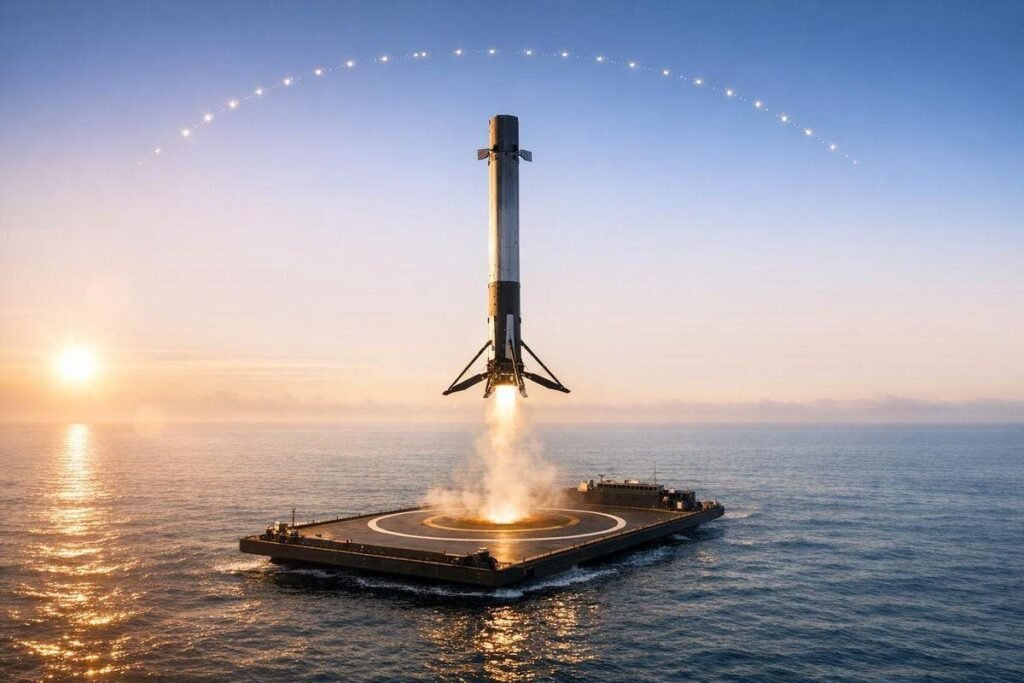
Its first-stage booster is designed to return to Earth after separating from the upper stage.
Following the separation, the booster performs a series of controlled maneuvers, including engine relights and aerodynamic adjustments, before attempting a landing.
Depending on the mission, the booster can land at a designated landing zone or on an autonomous drone ship positioned in the ocean.
After recovery, the hardware can undergo inspections and preparation for another flight.
This approach has fundamentally changed how SpaceX manages its launch operations.
Instead of treating each booster as a single-use component, the company has developed a fleet of reusable rockets that can support multiple missions.
The benefits include:
- Reduced demand for manufacturing new first-stage boosters.
- Greater flexibility in scheduling launches.
- More efficient use of existing rocket hardware.
- Operational experience accumulated through repeated flights.
- The potential to reduce launch costs over time.
However, reusability does not mean that every part of the rocket is reused. The upper stage remains expendable on standard Falcon 9 missions, and boosters still require inspection and maintenance.
Nevertheless, recovering and reusing the first stage has become one of the most important developments in modern commercial spaceflight.
From Occasional Launches to an Industrial-Scale Operation
One of the most impressive aspects of Falcon 9 is the frequency of its operations.
Historically, launching a rocket was a major logistical undertaking involving extensive preparation, testing, manufacturing, and coordination.
SpaceX has worked to turn this process into a more standardized operation.
The company’s growing launch infrastructure, reusable boosters, established manufacturing processes, and experience with mission preparation have helped increase its operational capacity.
The October 2026 milestone demonstrates how far this model has progressed.
A rocket family that first flew in 2010 has evolved into a launch system capable of supporting a very high number of missions over its operational lifetime.
This matters because access to space is not determined solely by the ability to build a powerful rocket.
It also depends on how frequently that rocket can fly, how reliably it can operate, and how much each mission costs.
SpaceX’s approach has placed all three factors at the center of its business strategy.
Starlink Is One of the Biggest Drivers of Falcon 9’s Success
An important reason behind Falcon 9’s extraordinary launch frequency is SpaceX’s Starlink satellite network.
Starlink is designed to provide broadband internet connectivity through a large constellation of satellites operating in low Earth orbit.
Building and maintaining such a network requires a continuous flow of satellites into space.
This creates a significant operational advantage for SpaceX.
Unlike launch companies that depend primarily on external customers, SpaceX has a major internal customer in the form of its own Starlink business.
The company can use Falcon 9 to deploy additional satellites, replace older spacecraft, and expand the network as demand develops.
This creates a powerful relationship between two parts of the business:
- Falcon 9 provides the launch infrastructure.
- Starlink creates recurring demand for launches and generates revenue through satellite internet services.
The integration of launch operations and satellite services gives SpaceX a business model that is difficult for traditional launch providers to replicate.
It also helps explain why Falcon 9 has become such an important part of the company’s long-term strategy.
What Does This Mean for the Economics of Space Exploration?
The economics of launching rockets have traditionally represented one of the biggest barriers to expanding commercial activity in space.
Building, preparing, and launching a rocket requires significant financial resources.
By recovering and reusing major rocket components, SpaceX has challenged the traditional cost structure of the industry.
Reusable boosters can reduce the amount of new hardware required for each mission, although the actual economics depend on refurbishment, maintenance, launch operations, and other costs.
Lower launch costs can potentially make more projects financially attractive.
These include:
- Satellite internet constellations.
- Earth observation services.
- Scientific research missions.
- Commercial communications satellites.
- Space-based infrastructure.
- Government and defense-related missions.
The broader implication is that more frequent and potentially more affordable access to space could support the development of entirely new industries.
However, cheaper launches alone do not guarantee commercial success. Satellite manufacturing, insurance, ground infrastructure, regulation, and customer demand remain important parts of the equation.
Competition Is Increasing: Can Other Companies Replicate SpaceX’s Model?
SpaceX’s success has put considerable pressure on other aerospace companies.
Traditional launch providers are increasingly being challenged to develop systems that offer greater flexibility, lower costs, and improved operational efficiency.
Companies around the world are investing in reusable rocket technology.
Blue Origin, for example, has developed the New Glenn launch vehicle, which also incorporates a reusable first-stage concept.
Rocket Lab is developing Neutron, another launch vehicle designed with reusability in mind.
Other companies are exploring different approaches to reducing launch costs and increasing access to orbit.
However, successfully landing a rocket is only one part of the challenge.
Building a commercially competitive launch business requires manufacturing capacity, reliable operations, experienced engineering teams, launch facilities, regulatory approvals, and sufficient customer demand.
SpaceX’s advantage is not simply its reusable rocket technology.
It is the entire operational ecosystem that the company has built around Falcon 9.
Replicating that ecosystem could prove considerably more difficult than developing a reusable rocket prototype.
Falcon 9 and the Road Toward Starship
Although Falcon 9 remains central to SpaceX’s current launch operations, the company is also developing Starship, a much larger launch system designed around full reusability.
The long-term ambition is to create a transportation system capable of supporting missions beyond Earth’s orbit, including lunar exploration and potentially human missions to Mars.
Starship represents a different scale of engineering ambition.
While Falcon 9 has demonstrated the commercial potential of reusing its first stage, Starship aims to take reusability further by recovering both major stages.
If successful, this could eventually create another major shift in the economics of space transportation.
However, Starship still faces substantial technical, operational, and regulatory challenges.
For now, Falcon 9 remains the proven workhorse behind SpaceX’s launch business.
Its 700-plus-flight milestone provides a remarkable demonstration of what reusable launch operations can achieve at scale.
Final Thoughts: SpaceX Has Made Rocket Launches Look Almost Routine
More than 700 Falcon 9 flights represent much more than an impressive statistic.
They reflect a fundamental change in how humanity approaches access to space.
When SpaceX began developing Falcon 9, reusable orbital rockets were widely viewed as an extremely difficult engineering challenge.
Today, recovering and reusing boosters has become a central part of the company’s launch strategy.
The achievement also highlights the importance of operational efficiency.
A successful rocket is not necessarily one that can fly once. The real challenge is building a system that can operate reliably, repeatedly, and at a commercially sustainable cost.
SpaceX has made significant progress toward that objective.
And while the future of the space industry will depend on more than Falcon 9, its impact is already difficult to ignore.
The next major revolution in space exploration may not simply be about building bigger rockets. It may be about making access to space increasingly routine.
For SpaceX, more than 700 Falcon 9 flights are another important step in that direction.
Sources and fact-checking
Space.com – Starlink 15-16 launch coverage.
Elon Musk’s original X post – October 31, 2026.
Spaceflight Now – Falcon 9 launch coverage.
Next Spaceflight – Starlink 15-16 mission.
Next Spaceflight – Starlink 15-18 mission.
Disclaimer – Editorial and Investment Information
This article is published for informational, educational, and journalistic purposes only. It is intended to provide general information about SpaceX, Falcon 9, reusable rocket technology, and developments in the commercial space industry.
Nothing in this article constitutes, or should be interpreted as, financial, investment, trading, or legal advice, or as a recommendation to buy, sell, or hold any security, financial instrument, or investment product.
References to SpaceX, Elon Musk, Starlink, or other companies and individuals are provided for informational and editorial purposes only. This article does not constitute an endorsement of any company, product, service, or investment opportunity.
Although reasonable efforts have been made to ensure the accuracy of the information presented, TickerRoast.com makes no representation or warranty, express or implied, regarding its completeness, accuracy, or continued relevance. Information may change, and certain figures or mission counts may differ between independent tracking sources.
Readers should independently verify information using official sources and conduct their own research before making any financial or investment decisions. Where appropriate, readers should consult a qualified financial professional.
TickerRoast.com shall not be held responsible for financial losses, decisions, or other consequences resulting from the use of information presented in this article, to the extent permitted by applicable law.
Editorial note: This article reflects an independent editorial analysis based on publicly available information. It does not necessarily represent the views of the companies or individuals mentioned.
Anonymous reader poll, just for fun. Not investment advice.
Read next



Get the daily market briefing
The stories that move markets, in your inbox every trading day at 9 a.m. ET. Free, unsubscribe anytime.