

Flying cars have been one of humanity’s most persistent technological dreams. For decades, science fiction has promised a future in which people could escape traffic jams, take off from their driveways, and travel across cities through the sky. Today, advances in electric propulsion, artificial intelligence, autonomous systems, and aerospace engineering are bringing parts of that vision closer to reality.
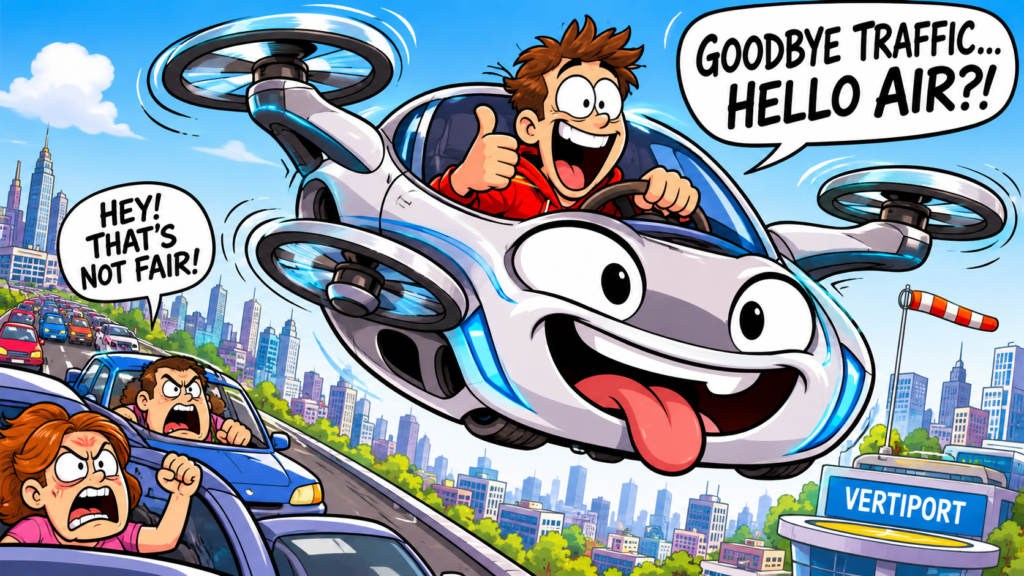
Companies around the world are developing vehicles capable of vertical takeoff and landing, while others are working on machines that can operate both on roads and in the air.
But an important question remains: just because we can build a flying car, does that mean we should?
The technology is no longer purely fictional. Prototypes have flown, electric aircraft are progressing through certification, and governments are preparing regulatory frameworks for a new generation of aerial transportation.
However, turning these experimental machines into affordable, safe, reliable, and widely accessible vehicles presents a much greater challenge.
The real question may not be whether flying cars are technically possible. It may be whether they can ever become practical enough to compete with conventional transportation.
1. The Flying Car Dream Is Older Than Most People Think
The idea of combining automobiles and aircraft is not new.
Long before modern electric vehicles and artificial intelligence, engineers were already experimenting with machines that could travel on roads and take to the skies.
One of the most notable historical examples was the Convair Model 118, developed in the 1940s. Another was the Fulton Airphibian, which became the first roadable aircraft to receive certification from the American Civil Aeronautics Administration in 1950.
These projects demonstrated that combining the two forms of transportation was technically achievable.
However, they also revealed a fundamental problem: designing a machine that performs well as both an automobile and an aircraft is extremely difficult.
A conventional car needs to be compact, relatively heavy, affordable, and efficient at low speeds. An aircraft, on the other hand, needs aerodynamic efficiency, carefully distributed weight, powerful propulsion, and highly reliable flight systems.
Combining these requirements often produces a compromise that is neither as efficient as a normal car nor as capable as a dedicated aircraft.
That fundamental engineering challenge has remained relevant for decades.
2. Are Flying Cars Technically Possible Today?
The short answer is yes.
Modern engineering has made flying vehicles considerably more realistic than they were in the twentieth century.
Several technological developments are contributing to this progress:
- Electric propulsion: Electric motors can provide efficient, precisely controlled propulsion and can power several independent rotors.
- Advanced batteries: Improvements in battery technology are making short-distance electric flight increasingly achievable.
- Lightweight materials: Carbon-fiber composites and advanced alloys can reduce aircraft weight while maintaining structural strength.
- Artificial intelligence: Software can help manage flight controls, navigation, obstacle detection, and operational safety.
- Vertical takeoff and landing: Multiple rotors or tilting propulsion systems can allow aircraft to take off without conventional runways.
One of the most important developments is the emergence of electric Vertical Take-Off and Landing aircraft, commonly known as eVTOLs.
Unlike traditional airplanes, these vehicles are designed to take off and land vertically, potentially allowing them to operate from specially designed locations within or near cities.
Some designs resemble large drones, while others look more like compact helicopters with multiple electric motors.
Companies such as Joby Aviation and Archer Aviation are developing aircraft intended to transport passengers over relatively short distances.
However, it is important to understand that an eVTOL is not necessarily a flying car.
Most current designs are aircraft rather than road vehicles. They are intended to operate in the air, not to replace the conventional automobile.
This distinction is essential when evaluating how close humanity really is to having flying cars.
3. Two Different Visions: Roadable Flying Cars and Electric Air Taxis
The expression “flying car” is often used to describe two very different technologies.
A. The traditional flying car
This is the vehicle most people imagine when thinking about the future.
It would function as a normal automobile on public roads but could also transform into an aircraft when necessary.
In theory, someone could drive to work, leave a road, activate the flight system, and fly over congested areas before returning to the road.
The concept sounds attractive, but it creates major engineering challenges.
A vehicle must carry the components required for both driving and flying, including road wheels, steering systems, suspension, aircraft wings or rotors, flight controls, and additional safety equipment.
These components add weight, complexity, maintenance requirements, and cost.
Furthermore, the aerodynamic characteristics required for efficient flight are very different from those required for comfortable everyday driving.
A flying car must therefore solve two demanding engineering problems simultaneously.
B. Electric air taxis
The second concept is considerably closer to commercial reality.
Instead of creating a vehicle that drives and flies, manufacturers are developing aircraft specifically designed for short-distance passenger transportation.
These vehicles could connect airports with city centers, transport passengers between business districts, or provide connections between locations that are difficult to reach by road.
An electric air taxi would not necessarily belong to an individual. It could operate more like a taxi, with passengers booking flights through a smartphone application.
This model avoids many of the complications associated with building a vehicle that must perform equally well on roads and in the air.
From a commercial perspective, it may also be easier to develop a transportation network around dedicated aircraft than to distribute millions of personal flying vehicles.
For this reason, electric air taxis are arguably a more realistic first step toward a future in which flying becomes part of everyday transportation.
4. The Biggest Obstacle: Battery Technology
One of the most important limitations facing electric flying vehicles is energy storage.
Electric cars have benefited enormously from improvements in lithium-ion batteries. However, aircraft face a much more demanding challenge.
A car can travel along a road while its weight is supported by its wheels. An aircraft must continuously generate enough lift to remain airborne.
Vertical takeoff is particularly energy-intensive because the vehicle must generate sufficient thrust to lift its entire weight directly against gravity.
This creates a serious limitation for battery-powered aircraft.
Even if a battery provides enough energy for a short flight, the aircraft must also retain sufficient reserves for unexpected situations, alternative landing locations, adverse weather, and other safety requirements.
A passenger aircraft cannot simply use every available unit of stored energy and hope to reach its destination.
Battery weight creates another problem.
Larger batteries provide more energy but also increase the aircraft’s weight. The additional weight requires more lift and therefore more energy.
This creates a difficult engineering balance between range, payload capacity, battery size, and operating efficiency.
For this reason, current electric aircraft projects are primarily focused on short- and medium-range applications.
Future improvements in battery chemistry, energy density, charging systems, and electric motors could expand their capabilities.
However, expecting battery-powered flying cars to offer the same range, flexibility, and affordability as conventional automobiles would be unrealistic in the near term.
5. Safety: A Much More Complicated Problem Than Driving
Safety could become one of the most important barriers to widespread adoption.
A road accident and an aircraft accident do not have the same consequences.
A conventional car can often stop on the side of the road when something goes wrong. A flying vehicle experiencing a serious propulsion failure at several hundred meters above the ground has far fewer options.
Flying vehicles must therefore be designed with extremely demanding safety requirements.
Potential risks include:
- Mechanical or electrical failures during flight.
- Battery overheating and thermal runaway.
- Sudden weather changes and strong winds.
- Software errors affecting flight controls.
- Communication failures.
- Navigation problems and mid-air collisions.
- Emergency landing limitations in densely populated areas.
Multi-rotor aircraft offer an interesting approach because they can distribute propulsion across several motors.
In certain designs, the failure of one motor may not immediately result in a loss of control.
However, redundancy does not eliminate every possible failure. Batteries, electrical systems, flight computers, structural components, and other critical systems must also be considered.
Another challenge is human error.
Operating an aircraft requires significantly more specialized knowledge than driving a conventional automobile.
Even if future systems become increasingly autonomous, regulators and manufacturers must demonstrate that these technologies can operate safely under a wide range of conditions.
The public will also need confidence that flying vehicles can be trusted above homes, roads, schools, and crowded urban areas.
6. Air Traffic: What Happens If Millions of People Start Flying?
Imagine a major city such as New York, London, Paris, or Tokyo.
Now imagine thousands of private flying vehicles attempting to travel between different locations at the same time.
The result could be a completely new transportation problem.
Road traffic is already difficult to manage. However, roads have established lanes, traffic lights, speed limits, signs, and clearly defined rules.
Airspace is considerably more complicated.
Aircraft must maintain safe separation distances, follow designated routes, respect restricted airspace, and communicate with relevant air traffic management systems.
Introducing large numbers of small flying vehicles into urban environments would require a sophisticated system capable of coordinating their movements.
Such a system could involve:
- Dedicated aerial corridors.
- Automated flight scheduling.
- Real-time collision avoidance.
- Advanced navigation systems.
- Continuous communication between aircraft and control systems.
- Designated takeoff and landing locations.
- Emergency response coordination.
Artificial intelligence could eventually help manage some of these operations.
However, autonomous flight management would need to meet strict reliability and cybersecurity requirements.
A software failure affecting one vehicle could potentially have consequences for other aircraft operating nearby.
The challenge is not simply teaching flying cars how to fly. It is ensuring that thousands of them can share the same airspace safely.
7. Infrastructure: Cities Are Not Designed for Flying Cars
Another major obstacle is infrastructure.
Most cities have been designed around roads, railways, airports, parking facilities, and pedestrian transportation.
They have not been designed to accommodate thousands of small aircraft taking off and landing throughout the day.
Electric air taxis would require dedicated locations known as vertiports.
These facilities could be built on rooftops, near airports, on the outskirts of cities, or at specially designated transportation hubs.
But creating such infrastructure is not as simple as installing a helipad.
Vertiports may require:
- Charging stations and high-capacity electrical connections.
- Passenger waiting and boarding areas.
- Fire protection systems.
- Aircraft maintenance facilities.
- Secure access and safety zones.
- Connections to existing public transportation.
There would also need to be sufficient space to accommodate takeoffs, landings, and emergency procedures.
The electrical grid presents another challenge.
If dozens of electric aircraft need to recharge simultaneously, the infrastructure must provide enough power without disrupting other electricity consumers.
According to a May 2026 report from the U.S. Government Accountability Office, 47 U.S. airports had identified electric aircraft charging stations in their plans as of December 2025.
The report also identified infrastructure costs, uncertain demand, and electricity availability as challenges.
This illustrates an important point: developing the aircraft is only one part of the problem. Building the transportation ecosystem around it could be just as difficult.
8. The Economic Question: Would Flying Cars Actually Be Affordable?
Even if engineers solve the technical challenges, the economics could prevent flying cars from becoming mainstream.
A conventional automobile is relatively inexpensive to manufacture, operate, park, and maintain.
A flying vehicle would require additional equipment, specialized components, regular inspections, and potentially expensive certification.
Insurance could also be significantly more complicated.
Aircraft maintenance is generally more demanding than ordinary vehicle maintenance because mechanical failures can have much more serious consequences.
There is also the question of operating costs.
Electric propulsion could reduce certain operating expenses compared with conventional helicopters, but that does not automatically make air transportation cheap.
Operators would still need to pay for:
- Aircraft acquisition and depreciation.
- Pilots and operational staff.
- Maintenance and inspections.
- Insurance.
- Electricity and charging infrastructure.
- Landing and facility fees.
- Regulatory compliance.
The result could be a transportation service that is affordable for wealthy individuals and business travelers but inaccessible to ordinary commuters.
This is where the flying car concept faces a fundamental economic problem.
People do not simply need a faster way to travel. They need a transportation solution that offers a meaningful improvement without dramatically increasing their expenses.
If a ten-minute flight costs several times more than a conventional taxi journey, most people will probably choose the road.
9. Could Flying Cars Actually Reduce Traffic Congestion?
At first glance, the answer seems obvious.
If vehicles can fly above traffic, they should be able to reduce congestion on roads.
However, the reality is more complicated.
Aerial transportation would not eliminate the need for passengers to travel between their homes, offices, airports, and other destinations.
Passengers would still need access to takeoff and landing facilities.
If vertiports are concentrated in a limited number of locations, people may need to travel by car or public transportation to reach them.
In addition, flying vehicles would have limited passenger capacity.
A typical air taxi is designed to carry only a small number of passengers. A train or metro system can transport hundreds or even thousands of people during the same period.
This difference in capacity is extremely important.
Even if flying taxis are faster for individual passengers, they may not be capable of replacing mass transportation in densely populated cities.
The most realistic outcome could be a complementary transportation system rather than a complete replacement for cars, buses, and trains.
Flying vehicles may prove particularly useful for airport transfers, connections between difficult-to-reach locations, emergency transportation, and certain premium travel services.
10. Environmental Impact: Are Electric Flying Cars Really Greener?
Electric flying vehicles are frequently presented as a cleaner alternative to helicopters and conventional aircraft.
They produce no direct exhaust emissions during electric flight, which could improve local air quality around operating areas.
Electric motors can also be quieter than conventional helicopter propulsion systems in certain operating conditions.
However, being electric does not automatically mean being environmentally friendly.
The overall environmental impact depends on several factors:
Electricity generation: The environmental benefits depend partly on whether the electricity used to charge the aircraft comes from renewable sources or fossil fuels.
Battery manufacturing: Producing large batteries requires raw materials, energy, and industrial processes that have environmental consequences.
Aircraft efficiency: Flying requires energy to overcome aerodynamic drag and maintain lift. A flying vehicle may consume more energy per passenger than a well-used electric train or bus.
Passenger capacity: An aircraft transporting two passengers may have a very different environmental footprint per passenger than one carrying four or five.
Infrastructure: Manufacturing aircraft, building vertiports, installing charging systems, and maintaining facilities all contribute to the overall environmental footprint.
The comparison must therefore consider the complete transportation system rather than simply comparing electric motors with combustion engines.
For certain journeys, electric air taxis could offer environmental improvements over helicopters or conventional aircraft.
But they are unlikely to be more energy-efficient than well-occupied trains for mass transportation.
11. Which Companies Are Leading the Flying Car Revolution?
Several companies are investing heavily in the development of electric aircraft and advanced air mobility.
Although their technologies differ, they are all exploring ways to make short-distance air transportation more accessible.
Joby Aviation
Joby Aviation is one of the most recognized companies in the eVTOL industry.
Its aircraft is designed to carry a pilot and several passengers, with the objective of providing short-distance electric air taxi services.
The company is working toward commercial operations and aircraft certification.
Its broader ambition is to create an aerial transportation network connecting airports, cities, and other important destinations.
Archer Aviation
Archer Aviation is another major player in the electric air mobility sector.
Its Midnight aircraft is designed for short urban and regional journeys.
The company has pursued partnerships and commercial development opportunities intended to establish electric air taxi services.
Like other manufacturers, Archer must demonstrate that its aircraft can meet demanding regulatory and operational requirements before large-scale passenger services become possible.
EHang
Chinese company EHang is developing autonomous electric vertical takeoff and landing aircraft.
Its approach is particularly interesting because it focuses on pilotless operations.
The company has obtained regulatory approvals in China for certain autonomous passenger-carrying aircraft operations.
However, regulatory approvals in one country should not be confused with authorization to operate commercially everywhere.
Other emerging players
Other companies, including manufacturers developing electric aircraft, hybrid propulsion systems, and advanced personal aviation vehicles, are also competing to shape the future of this industry.
The important distinction is that these companies are not all building traditional flying cars.
Many are developing specialized aircraft that could become part of a broader aerial transportation ecosystem.
Their success will depend not only on technological innovation but also on certification, financing, infrastructure, public acceptance, and commercial demand.
12. What Do Regulators Think About Flying Cars?
Regulatory approval is one of the most important steps between an experimental aircraft and a real transportation service.
Aircraft cannot simply enter commercial passenger operations because a manufacturer has successfully completed a demonstration flight.
They must satisfy demanding airworthiness and operational requirements.
In the United States, the Federal Aviation Administration (FAA) is evaluating new electric aircraft designs and developing regulatory approaches for these technologies.
A May 2026 report from the Government Accountability Office noted that, as of March 2026, the FAA had not issued a type certification for a manned electric aircraft for commercial operations.
The report also highlighted the challenges of integrating these aircraft into existing airspace and developing the necessary infrastructure.
In Europe, the European Union Aviation Safety Agency (EASA) is also working on the regulatory framework for Urban Air Mobility.
The agency identifies electric propulsion and vertical takeoff technologies as important developments that could enable new forms of passenger transportation.
However, certification and large-scale commercial deployment remain separate challenges.
A certified aircraft does not automatically mean that a city has the infrastructure, operating procedures, and airspace capacity needed to support hundreds of daily flights.
The regulatory process is therefore likely to play a decisive role in determining how quickly this industry develops.
13. When Could Flying Cars Become a Reality?
The answer depends on which type of flying vehicle we are discussing.
Electric air taxis could become commercially available before traditional personal flying cars.
Their operations would initially be limited to specific routes, approved locations, and relatively short distances.
A gradual development could look something like this:
2026–2030: Early commercial development
The industry could move from experimental testing toward limited commercial operations in selected markets, subject to certification and regulatory approval.
Initial services would probably focus on airport transfers, premium passenger transportation, and specialized applications.
2030–2035: Expansion of selected networks
If the technology proves safe and economically viable, additional routes and operating locations could emerge.
Improvements in charging infrastructure, aircraft production, and flight management could help expand operations.
Autonomous technologies may also progress, although their deployment would depend on regulatory approval.
2035–2045: Greater integration into transportation systems
In an optimistic scenario, some large cities could develop more extensive aerial transportation networks.
However, widespread adoption would still depend on costs, public acceptance, energy efficiency, and infrastructure investment.
Beyond 2045: The possibility of personal flying vehicles
Traditional roadable flying cars could become more practical if major improvements in batteries, materials, automation, and propulsion systems occur.
But there is no guarantee that they will become affordable or widely adopted.
These periods should be understood as illustrative development scenarios, not confirmed industry deadlines.
The technology could progress faster in certain applications and much more slowly in others.
14. The Real Problem: Just Because Something Is Possible Does Not Mean It Is Useful
Perhaps the most important question surrounding flying cars is not technological.
It is practical.
Humanity has developed many technologies that work perfectly well in controlled environments but struggle to become commercially successful.
A flying vehicle might be capable of taking off vertically, reaching high speeds, and transporting passengers across a city.
But if it costs too much, requires specialized infrastructure, consumes excessive energy, or introduces unacceptable safety risks, it may never become a mainstream transportation solution.
Consider the smartphone.
It became one of the most successful technologies in modern history because it combined multiple useful functions into a relatively affordable and convenient device.
Flying cars face a much more difficult challenge.
They must offer a clear advantage over existing transportation options while maintaining the safety standards expected of aviation.
For millions of ordinary people, a vehicle that can fly but costs several hundred thousand dollars may be less attractive than a conventional electric car, a high-speed train, or an efficient public transportation network.
This does not mean the technology has no future.
It means that its most successful applications may be very different from the vision originally imagined in science fiction.
15. The Most Likely Future: Flying Taxis Rather Than Flying Cars
Looking at the technological, economic, and regulatory challenges, the most realistic future is probably not a world where every family owns a flying car.
Instead, aerial transportation could become a specialized service integrated into existing transportation networks.
Imagine arriving at a major airport and booking a short electric aircraft journey to a business district.
Or imagine an air taxi connecting two locations separated by mountains, water, or heavily congested roads.
In these situations, the time saved could justify the additional cost.
Medical transportation, emergency response, remote-area connectivity, and certain logistics operations could also benefit from advanced electric aircraft.
These applications do not require every citizen to own a flying vehicle.
They require a limited number of aircraft, trained operators, designated routes, and reliable infrastructure.
From an economic perspective, that may be a much more sustainable business model.
Final Verdict: Will Flying Cars Ever Become Part of Everyday Life?
Flying cars are technically possible, and the progress made in electric propulsion, battery systems, automation, and aerospace engineering is bringing certain forms of aerial transportation closer to reality.
However, the traditional idea of a personal vehicle that can seamlessly drive through city streets and fly whenever its owner chooses remains a considerably more difficult challenge.
The obstacles are not limited to engineering.
Battery limitations, safety requirements, air traffic management, infrastructure costs, environmental considerations, and economic viability all stand in the way of mass adoption.
Electric air taxis have a more realistic path toward commercial deployment because they focus on specific transportation needs rather than trying to replace conventional automobiles entirely.
Ultimately, the future of flying cars may not look like the one imagined in science fiction.
Instead of millions of private flying vehicles filling the skies, we may see a smaller network of electric aircraft serving airports, business centers, remote communities, and specialized transportation markets.
The sky may become another transportation option, but that does not necessarily mean it will become the next highway.
The technology can work. The real challenge is making it safe, affordable, efficient, and useful enough for ordinary people.
Anonymous reader poll, just for fun. Not investment advice.
Read next



Get the daily market briefing
The stories that move markets, in your inbox every trading day at 9 a.m. ET. Free, unsubscribe anytime.