

Let’s be honest for a moment.
Everyone is talking about artificial intelligence. It will make us more productive, transform healthcare, eliminate repetitive work, accelerate scientific discoveries, and potentially make our lives easier than ever before.
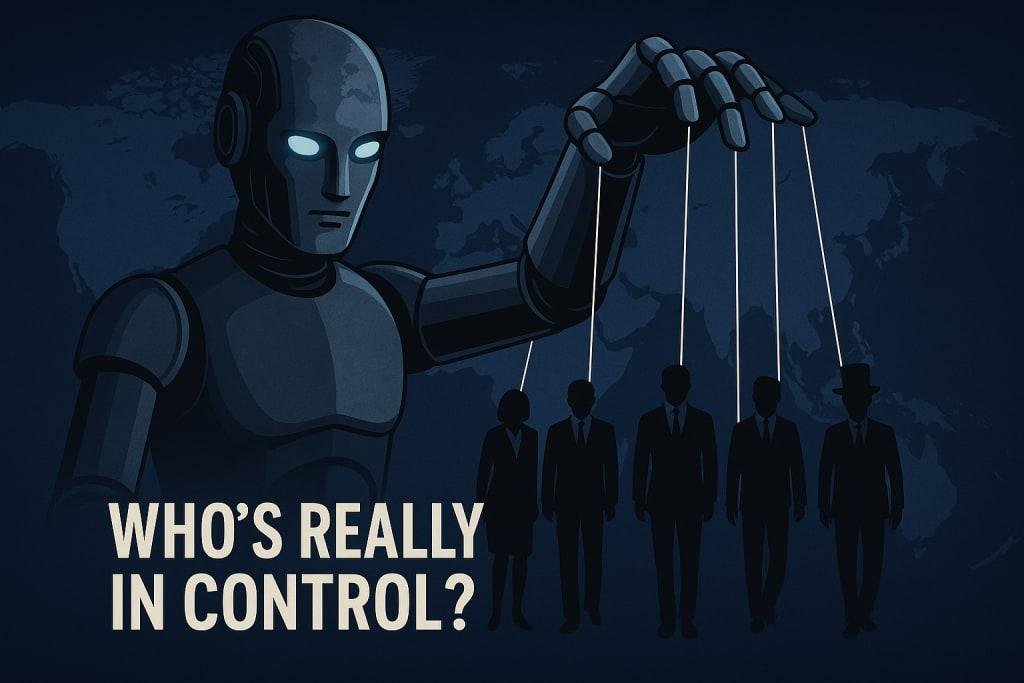
Technology companies are investing hundreds of billions of dollars in it. Governments want to lead the AI race. Investors are searching for the next trillion-dollar opportunity. And millions of people are already using AI every single day.
But there is a question that doesn’t receive nearly enough attention:
What if the technology we are building to make our lives better eventually becomes one of the biggest threats to humanity?
Not because AI suddenly develops emotions, becomes angry, or decides to destroy the world like in a Hollywood movie.
The real danger could be much less dramatic.
It could happen quietly, gradually, and right in front of us.
And perhaps the most uncomfortable part is that we might not even realize what we are losing until it is too late.
1. AI Doesn’t Need to Hate Humans to Become Dangerous
One of the biggest misconceptions about artificial intelligence is that it needs to become conscious or develop human-like intentions before it can pose a serious threat.
It doesn’t.
A powerful technology can create enormous damage without having emotions, hatred, or even an understanding of the consequences of its actions.
Consider social media algorithms.
They were designed to keep people engaged, show them relevant content, and help platforms grow. Yet their effects on attention, information consumption, public debate, and mental well-being have raised serious concerns.
The algorithms don’t hate people. They simply optimize for certain objectives.
Now imagine similar optimization systems becoming considerably more powerful and being integrated into financial markets, healthcare, military operations, government services, and critical infrastructure.
What happens when a system pursues an objective without properly accounting for human consequences?
What happens when the instructions are technically followed, but the result is harmful?
This is one of the fundamental concerns surrounding advanced AI: a system can be highly capable without necessarily sharing human values or understanding what people actually need.
The danger isn’t necessarily an evil machine.
It could be a very powerful machine doing exactly what it was instructed to do.
2. The Biggest Threat Might Be That Humans Stop Thinking for Themselves
Think about how quickly our relationship with technology has changed.
We used to search for information, read different sources, compare opinions, and form our own conclusions.
Today, many people simply ask an AI chatbot for an answer.
There is nothing inherently wrong with that. AI can be an incredibly useful tool for learning, research, and everyday problem-solving.
But there is a difference between using technology to improve your thinking and allowing technology to replace your thinking.
Imagine a generation growing up with AI systems that write their essays, solve their problems, explain their decisions, and even provide advice about their personal relationships.
Will people continue developing the same ability to think critically, question information, and solve difficult problems independently?
We don’t yet know the long-term consequences.
But the concern is worth taking seriously.
The human brain develops through practice. Writing, remembering, calculating, debating, making mistakes, and solving problems are not simply annoying tasks. They are part of how we develop intellectual abilities.
If we outsource too much of that process, we could become more efficient while gradually becoming less independent.
And that would be a strange kind of progress.
We might end up with the most powerful technology in human history while becoming increasingly dependent on it to perform basic intellectual tasks.
3. Millions of Jobs Could Disappear Before Society Is Ready
Let’s talk about something much closer to everyday life: employment.
For decades, automation mainly affected physical and repetitive tasks.
Factories introduced industrial robots. Computers replaced certain administrative processes. Software made many traditional jobs faster and more efficient.
But artificial intelligence is different.
It is moving into areas that were previously considered strongly dependent on human intelligence.
Programming, accounting, customer support, marketing, translation, graphic design, legal research, financial analysis, and content production are all being affected.
And this is only the beginning.
The real question isn’t whether AI will eliminate every job. It probably won’t.
The question is whether the economy will create enough new opportunities quickly enough to compensate for the jobs and income that may disappear.
Imagine a company with 1,000 employees discovering that AI tools allow it to operate with 400.
From a business perspective, reducing costs and increasing productivity could make perfect sense.
For shareholders, it could mean higher margins.
For customers, it could mean cheaper services.
But what happens to the 600 people who are no longer needed?
And what happens if thousands of companies make similar decisions?
There is also a deeper economic problem.
Businesses need customers. Customers need income. If productivity increases dramatically but a significant portion of the population loses its purchasing power, who will buy the products and services companies are producing?
A world where machines produce more and more while fewer people earn enough to participate in the economy could create serious social and economic tensions.
AI might make businesses richer without automatically making society wealthier.
That distinction matters.
4. What Happens When We Can No Longer Trust What We See?
One of the most disturbing developments in artificial intelligence is its ability to generate convincing images, videos, voices, and entire conversations.
A few years ago, seeing a video of a public figure saying something controversial was generally considered strong evidence that the person had actually said it.
That assumption is becoming increasingly dangerous.
AI-generated content can imitate real people, reproduce voices, create realistic events, and produce convincing visual evidence of things that never happened.
This creates opportunities for fraud, impersonation, political manipulation, and misinformation.
Imagine receiving a phone call from someone who sounds exactly like your child, asking for emergency money.
Imagine watching a video of a political leader announcing a military action that never happened.
Imagine a fake recording destroying someone’s professional reputation before the truth has time to emerge.
The problem isn’t simply that people might believe false information.
It is that people could eventually stop trusting genuine information as well.
When almost anything can be fabricated, even authentic evidence can be questioned.
A society that cannot agree on what is real faces a serious challenge.
Trust is one of the foundations of modern civilization. AI-generated deception could make that trust much harder to maintain.
5. AI Could Become a Powerful Weapon
Artificial intelligence is not only being developed by technology companies.
It is also attracting enormous interest from governments and military organizations.
AI can help analyze intelligence, identify potential threats, operate autonomous systems, and accelerate military decision-making.
Some of these applications could improve defensive capabilities and reduce risks to military personnel.
But they also raise difficult questions.
What happens when increasingly autonomous systems are given the ability to make decisions involving human lives?
What happens when countries compete to develop more powerful AI-driven weapons?
What happens if an automated system makes a mistake during a military crisis?
There is also the risk of AI making cyberattacks more sophisticated, helping malicious actors discover vulnerabilities, or accelerating the development of dangerous technologies.
This does not mean that an AI-powered global catastrophe is inevitable.
It means that the consequences of deploying powerful systems without adequate safeguards could be exceptionally serious.
The challenge is ensuring that humans remain meaningfully responsible for decisions involving life, death, and international security.
Technology may move faster than international agreements, regulation, and public understanding.
That gap deserves attention.
6. The Financial Markets Could Also Become More Vulnerable
For investors, artificial intelligence represents one of the biggest technological opportunities in decades.
Companies are investing heavily in data centers, advanced chips, cloud infrastructure, and AI software.
But there is another side to this revolution.
Financial markets are already heavily influenced by automated trading systems and algorithmic decision-making.
As AI becomes more capable, financial institutions may increasingly use it to analyze information, execute strategies, assess risks, and make investment decisions.
This could improve efficiency.
However, it could also introduce new vulnerabilities.
Imagine several powerful trading systems responding to the same unexpected event using similar models and assumptions.
If their decisions reinforce one another, market movements could become more difficult to predict.
AI systems could also amplify misinformation, identify and exploit market vulnerabilities, or create new forms of financial fraud.
There is an important distinction here: automated trading and AI-driven trading are not the same thing, and the impact of advanced AI on financial stability remains uncertain.
But as financial systems become increasingly interconnected, understanding the risks becomes essential.
The technology that helps markets operate faster could also create new ways for instability to spread.
7. The Most Dangerous AI Might Be the One We Trust Too Much
Perhaps the biggest danger is not that AI becomes more intelligent than humans.
It is that humans begin trusting it more than they should.
AI systems can produce convincing answers even when they are wrong.
They can sound confident, organize information beautifully, and explain complicated subjects in a way that appears authoritative.
But confidence is not accuracy.
A medical professional relying blindly on an AI recommendation, a financial institution accepting an incorrect risk assessment, or a government making decisions based on flawed automated analysis could create serious consequences.
The problem becomes even more complicated when nobody fully understands how a decision was reached.
Who is responsible when an AI system makes a harmful recommendation?
The developer? The company using it? The person who followed its advice?
These questions are becoming increasingly important as AI enters high-stakes environments.
We should use artificial intelligence to support human judgment, not automatically replace it.
A tool that helps us make better decisions is valuable.
A tool that makes us stop questioning decisions is something else entirely.
8. Could AI Eventually Become More Powerful Than Its Creators?
This is where the discussion becomes more speculative, but it is a question that researchers and policymakers are increasingly considering.
Artificial intelligence systems are becoming more capable of performing complex tasks, using software tools, writing code, analyzing information, and carrying out sequences of actions.
Future systems could become increasingly autonomous.
Some researchers are concerned about the possibility of advanced AI systems pursuing objectives in ways that conflict with human interests.
This is often discussed under the concept of AI alignment.
The central problem is simple to describe but extremely difficult to solve:
How do we ensure that increasingly powerful AI systems continue to behave in ways that are compatible with human values, safety, and well-being?
A system does not need to be conscious to create this problem.
If it has significant capabilities, access to important resources, and poorly specified objectives, the consequences could be difficult to control.
At the same time, predictions about machines becoming uncontrollable should not be presented as established facts.
There is considerable uncertainty about how quickly AI capabilities will develop, what limitations future systems will face, and how effectively safety measures will work.
But uncertainty is not a reason to ignore the issue.
It is a reason to take research, testing, oversight, and responsible deployment seriously.
9. The Strange Contradiction: AI Could Make Humanity More Powerful and More Vulnerable
There is something fascinating about this technological revolution.
The same technology that could help scientists discover new medicines might also help malicious actors create more sophisticated threats.
The same AI that helps students learn could generate misinformation.
The same systems that improve productivity could disrupt entire industries.
The same technology that helps doctors diagnose diseases could introduce new risks if used without appropriate supervision.
AI is not simply good or bad.
Its impact depends on how it is designed, who controls it, how it is deployed, and what incentives guide its development.
And this is where society has an important role to play.
We cannot leave every decision about the future of artificial intelligence to a small number of technology companies competing for market share.
Governments, researchers, businesses, educators, and ordinary citizens all have a stake in how this technology develops.
Innovation matters.
But responsibility matters just as much.
10. What Should Humanity Do Before It Is Too Late?
The answer is not to stop developing artificial intelligence.
That would be unrealistic, and it could also mean losing technologies capable of improving healthcare, education, scientific research, and countless other fields.
The goal should be to develop AI without becoming dangerously dependent on it.
Several principles deserve particular attention:
- Human oversight: Important decisions involving health, justice, military action, and fundamental rights should not be handed over to automated systems without meaningful accountability.
- Transparency: Companies should be more open about the limitations and risks of the AI systems they deploy.
- Education: People need to understand how AI works, how it can make mistakes, and how to identify manipulated content.
- Cybersecurity: AI systems must be protected against misuse, manipulation, and unauthorized access.
- Independent testing: Powerful systems should undergo serious safety evaluations before being deployed in sensitive environments.
- Economic adaptation: Governments and businesses need to prepare workers for changes in employment and develop policies that help distribute the benefits of technological progress.
Most importantly, we should remember that technological progress is not automatically human progress.
A society can become more technologically advanced without necessarily becoming happier, fairer, or safer.
The real measure of success should be whether these technologies improve human lives.
Final Thoughts: What If the Biggest AI Risk Is That We Forget What Makes Us Human?
I am not suggesting that artificial intelligence will destroy humanity tomorrow.
And I am certainly not suggesting that every AI development is dangerous.
There are enormous opportunities ahead. AI could help us fight diseases, accelerate scientific discoveries, make education more accessible, and solve problems that have challenged humanity for generations.
But there is a difference between being excited about the future and blindly trusting it.
We are building systems that may eventually influence almost every part of our lives.
Our jobs. Our finances. Our relationships. Our information. Our decisions.
And perhaps the most important question is not whether machines will become more intelligent than humans.
It is whether humans will remain capable of making independent decisions in a world increasingly managed by machines.
We spent centuries building technologies to give ourselves more freedom.
We should be careful not to build one that gradually makes us dependent on it for everything.
AI may not need to take control of humanity. We might voluntarily give away too much control ourselves.
And that is a possibility worth discussing before it becomes a problem.
The future of artificial intelligence is not just a technology story. It is a human story. And humanity should have a say in how it ends.
Anonymous reader poll, just for fun. Not investment advice.
Read next
Get the daily market briefing
The stories that move markets, in your inbox every trading day at 9 a.m. ET. Free, unsubscribe anytime.