

October 22, 2026 | TickerRoast Markets Analysis
Meta Platforms (NASDAQ: META) closed at $647.08 on Thursday, Oct. 22, 2026, down 7.23%, the day after it reported third-quarter results. Revenue beat consensus and fourth-quarter guidance came in above expectations. Investors focused instead on negative free cash flow, a higher floor for 2026 capital spending and a record reading on Meta’s credit default swaps. Meta and Tesla led a broad technology sell-off that pulled the Nasdaq Composite down 2.4%, according to CNBC. In our view, the reaction shows the market now looks hard at how AI spending gets paid for, and is no longer rewarding the spending by itself.
What happened
Meta reported results for the quarter ended Sept. 30, 2026 after the market closed on Wednesday, Oct. 21. According to the company’s press release, revenue rose 26% year over year to $64.60 billion. Operating income fell 37% to $12.99 billion, and the operating margin narrowed to 20% from 40%. Total costs and expenses rose 68% to $51.61 billion, a figure that includes a legal charge of roughly $9.9 billion. Net income was $9.86 billion, or $3.83 per diluted share. Year-over-year comparisons for net income and EPS are distorted because tax expense in the third quarter of 2025 was unusually high (an 87% effective tax rate).
According to a StockStory report on Yahoo Finance, consensus expected revenue of $63.35 billion, so Meta beat by about 2%. The midpoint of fourth-quarter revenue guidance was about 1.2% above analyst estimates. The shares still fell on Thursday. CNBC reported that Meta slipped 7% even though it beat revenue expectations and gave upbeat guidance. On the same day the Nasdaq Composite lost 2.4% and the S&P 500 lost 1.3%. Chip stocks also fell: Advanced Micro Devices dropped more than 7%, Micron about 5% and Nvidia about 4%, according to CNBC.
| Metric (Q3 2026) | Value | Source |
|---|---|---|
| Revenue | $64.60bn (+26% y/y) | Meta press release |
| Operating income / margin | $12.99bn / 20% (vs. 40%) | Meta press release |
| Diluted EPS | $3.83 | Meta press release |
| Capex incl. finance-lease principal | $34.91bn | Meta press release |
| Free cash flow | −$2.12bn | Meta press release |
| Cash & marketable securities | $82.45bn | Meta press release |
| Q4 2026 revenue guidance | $73–76bn | Meta 8-K |
| FY2026 capex guidance | $135–145bn (prior $130–145bn) | Meta 8-K |
| Close, Oct. 22, 2026 | $647.08 (−7.23%) | Yahoo Finance data |
Why the stock moved
Capex and cash flow. According to the CFO outlook filed with the SEC, Meta now expects 2026 capital expenditures, including principal payments on finance leases, of $135–145 billion. The prior range was $130–145 billion, so the low end went up while the top end stayed the same. Third-quarter capex was $34.91 billion. Operating cash flow was $32.79 billion, which left free cash flow at negative $2.12 billion. CNBC named negative free cash flow and the higher capex floor as the main reasons for the decline. By our calculation, capex was about 54% of quarterly revenue.
Credit concerns. Bloomberg reported that a measure of Meta’s credit risk hit a record on Thursday and that its bonds weakened. The spending plans revived fears that big tech companies will issue more debt to fund the AI buildout. Citing ICE Data Services, Bloomberg said five-year credit default swaps on Meta rose as much as 8.9 basis points to about 119.3 basis points. That is the highest intraday level since the contracts began trading actively about a year ago. CDS on Oracle, Microsoft and Broadcom also rose. On the earnings call, Meta said it ended the quarter with $82.4 billion in cash and marketable securities and $83.7 billion in debt, according to a transcript published by The Motley Fool.
Funding commentary and a new share class. CNBC cited a note from Wells Fargo traders saying that Meta’s comments about how much AI funding it needs made the shares reverse and weighed on the wider market. Meta also announced a new class of nonvoting Class C stock. Bloomberg reported that the new shares could eventually be used to help pay for acquisitions and other expenses. According to the call transcript, management said the plan comes with a 2-for-1 stock split, with trading expected to begin in late January 2027. In our view, a large capex budget, negative free cash flow and a new equity currency all arriving together made it easier for investors to worry about financing.
Business and financial analysis
The advertising business looks healthy on the reported numbers. According to Meta’s Form 10-Q, ad impressions rose 10% year over year and the average price per ad rose 14%. Together these show both volume and pricing growth. Excluding the roughly $9.9 billion legal charge, operating income would have been about $22.9 billion. By our calculation that is an underlying margin of about 35%, against 40% a year earlier. So margins are still compressing even without the one-off charge, which we attribute mainly to higher infrastructure and AI costs.
Management guided full-year 2026 total expenses to $175–179 billion, up from before to include the legal charge. It still expects 2026 operating income, excluding that charge, to be above 2025. It now expects Reality Labs losses of $18–19 billion in 2026, and the call transcript shows management expects them to narrow to about $15 billion in 2027. According to Investing.com’s call summary, Meta has not yet given 2027 capex guidance and is still building its budget. Before the report, Barron’s said Guggenheim’s Michael Morris had raised his 2027 capex estimate for Meta to $225 billion from $203 billion, as reported on Oct. 14. That figure is one analyst’s estimate, not company guidance.
Meta is also trying to earn money from AI outside advertising. CNBC reported on Oct. 12 that Meta’s new Muse Wonder model is only available through paid subscriptions to the Muse app, at $20 or $100 a month. In our view, early evidence on uptake will matter for the valuation debate. Paid adoption would give investors a measurable return on the AI buildout beyond better ad targeting. Any forecast of that adoption is highly uncertain.
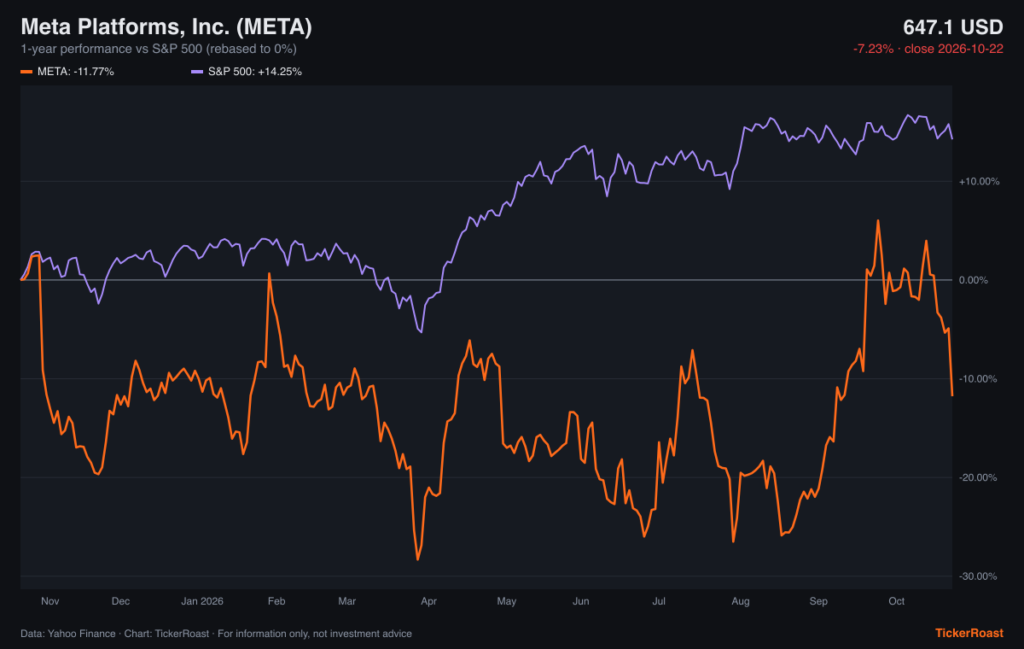
Valuation context. StockStory put Meta’s market capitalization at about $1.77 trillion around the time of the report. In the year to Oct. 22, the stock fell 11.77% while the S&P 500 gained 14.25%, a gap of about 26 percentage points. Year to date the shares are down 0.51%. In our view, the market is applying a higher risk premium to companies whose free cash flow is being absorbed by AI capex. That differs from earlier phases of the AI trade, when spending plans tended to lift these stocks.
Technical picture
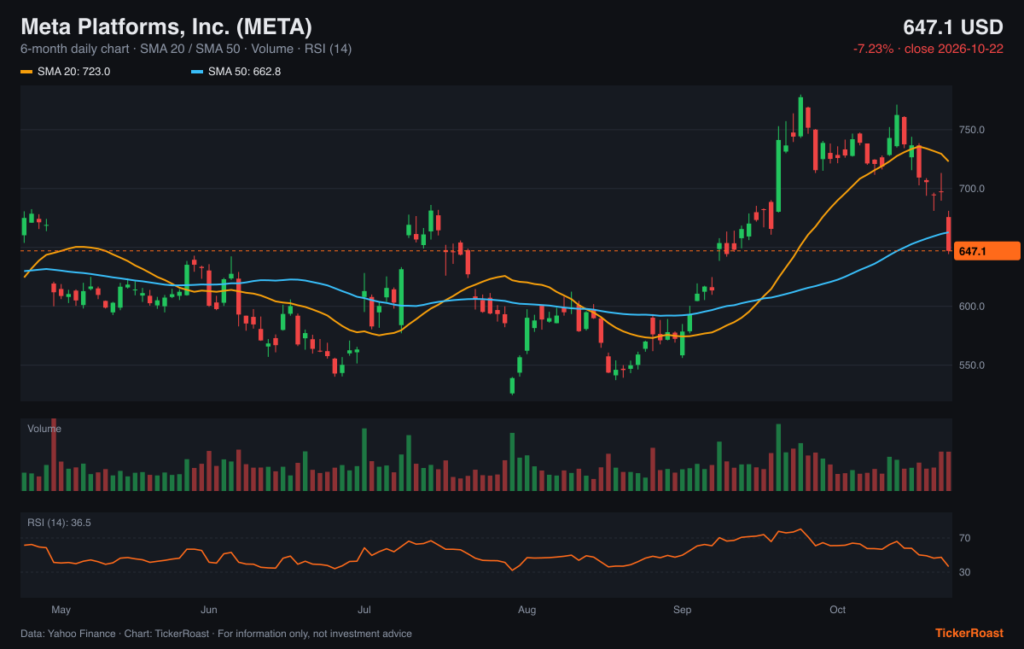
The chart covers six months of daily candles with the 20- and 50-day simple moving averages, volume and the 14-day RSI. Meta closed at $647.08 on Oct. 22. That is about 10.5% below the 20-day SMA ($723.01) and 2.4% below the 50-day SMA ($662.83). It is still about 2.3% above the 200-day SMA ($632.55). The stock is 17.0% below its 52-week high of $779.82 and 24.4% above its 52-week low of $520.26. It is down 13.04% over one month but up 8.72% over three months.
Volume was 28.59 million shares, about 1.47 times the 20-day average of 19.49 million. That points to broad selling rather than a thin-market move. The 14-day RSI is 36.53, weak but above the 30 level often treated as oversold. Technical indicators describe past price action. They do not predict future moves.
Key risks
- Capital intensity: 2026 capex guidance of $135–145 billion and no 2027 framework yet leave room for free cash flow to stay negative if spending keeps rising.
- Financing and credit: record CDS levels (Bloomberg/ICE) show bond investors are paying more for protection, and further debt issuance across the sector could widen spreads.
- Legal and regulatory: the roughly $9.9 billion third-quarter legal charge shows that litigation can hit reported earnings hard.
- Monetisation risk: paid AI products such as Muse Wonder are new, and their revenue contribution has not been shown yet.
- Sector contagion: on Oct. 22 AI-linked stocks including AMD, Micron and Nvidia fell alongside Meta (CNBC), so sector sentiment can move the stock regardless of company results.
- Macro: CNBC also cited higher oil prices and geopolitical tensions as pressures on the market that day.
What investors will watch next
- Meta’s first 2027 capex and expense guidance, which management said will come later.
- Fourth-quarter revenue against the $73–76 billion guided range.
- Movements in Meta’s five-year CDS and any new bond issuance by Meta or other hyperscalers.
- Details and timing of the Class C share structure and 2-for-1 split, expected to start trading in late January 2027.
- Subscriber and engagement data for the Muse app and Muse Wonder.
- Results and capex commentary from other AI-exposed megacaps, which may shape sentiment across the sector.
Conclusion
Meta’s third quarter delivered 26% revenue growth, a revenue beat and fourth-quarter guidance above consensus. The shares still dropped 7.23% on volume well above average. The reasons, as reported by CNBC and Bloomberg, were negative free cash flow, a higher floor for capex, record credit-protection costs and concern about how the AI buildout will be funded. In our view, the main open question is whether returns on Meta’s AI infrastructure arrive fast enough to justify its spending, both in the core ad business and in new paid products. Upcoming 2027 guidance will be an important data point, though any outlook is uncertain.
Sources
- Meta Reports Third Quarter 2026 Results — Meta Platforms
- Meta Platforms, Inc. Form 8-K Exhibit 99.1 (Q3 2026) — SEC
- Meta Platforms, Inc. Form 10-Q (Q3 2026) — SEC
- Nasdaq tumbles 2% on AI spending concerns and jump in oil prices: Live updates — CNBC
- Meta stock sinks 6% as AI spend pushes free cash flow negative — CNBC
- Meta Credit Risk Jumps to Record as AI Spending Plans Weigh on Bonds — Bloomberg
- Meta Falls After Boosting Spending Plans for AI Bet — Bloomberg
- Meta (META) Q3 2026 Earnings Call Transcript — The Motley Fool
- Meta’s Q3 2026 sales top estimates, quarterly revenue guidance slightly exceeds expectations — Yahoo Finance / StockStory
- Meta debuts Muse Wonder AI model in latest test of users’ willingness to pay — CNBC
- Meta Stocks Fall 3.7% as Analyst’s $225 Billion Spending Forecast Raises Stakes — TradingView / GuruFocus
Market data: Yahoo Finance, close of 2026-10-22. Charts generated by TickerRoast from this data.
Disclaimer: This article is for informational and educational purposes only. It provides general financial and business analysis and does not constitute investment advice, a personal recommendation, a recommendation to buy, sell or hold any security, or an offer to transact in any financial instrument. Information is based on publicly available sources as of October 22, 2026 and market data as of the 2026-10-22 close (Yahoo Finance). Past performance is not a reliable indicator of future results; forecasts are uncertain and actual results may differ materially. Investing in shares involves risk, including the loss of capital. The publisher does not guarantee the accuracy or completeness of the information and accepts no responsibility for investment decisions made on the basis of this article. Readers should consult official company disclosures, conduct their own research and, where appropriate, seek advice from a licensed financial adviser. Any relevant financial interests held by the author or publisher in the securities mentioned are disclosed where applicable. This article was prepared with the assistance of AI tools and is based on the sources listed above.
Related reading
- A $25 Billion Fine, Then a Cash Burn: Inside Meta’s Rough Week, as I See It
- The Week That Could Decide the AI Trade: My Notes Before the Fed and Big Tech Earnings
- Nasdaq Suffers Its Worst Day Since June: Is This a Market Correction?
Anonymous reader poll, just for fun. Not investment advice.
Read next
Get the daily market briefing
The stories that move markets, in your inbox every trading day at 9 a.m. ET. Free, unsubscribe anytime.