

October 21, 2026 | TickerRoast Markets Analysis
SpaceX is attracting attention in premarket trading as investors assess the company’s latest financial disclosures, its satellite internet business and its long-term growth opportunities.
A sharp share-price increase can reflect changing expectations about a company’s future, but it does not automatically mean that its business has improved by the same amount. To understand a market move, investors need to distinguish between reported financial performance, potential growth drivers and market sentiment.
This analysis examines SpaceX’s business model, Falcon 9 reusability, Starlink’s commercial potential, valuation considerations and the technical indicators relevant to a premarket move. Company-related facts should be checked against official disclosures, while share-price movements require reliable market data.
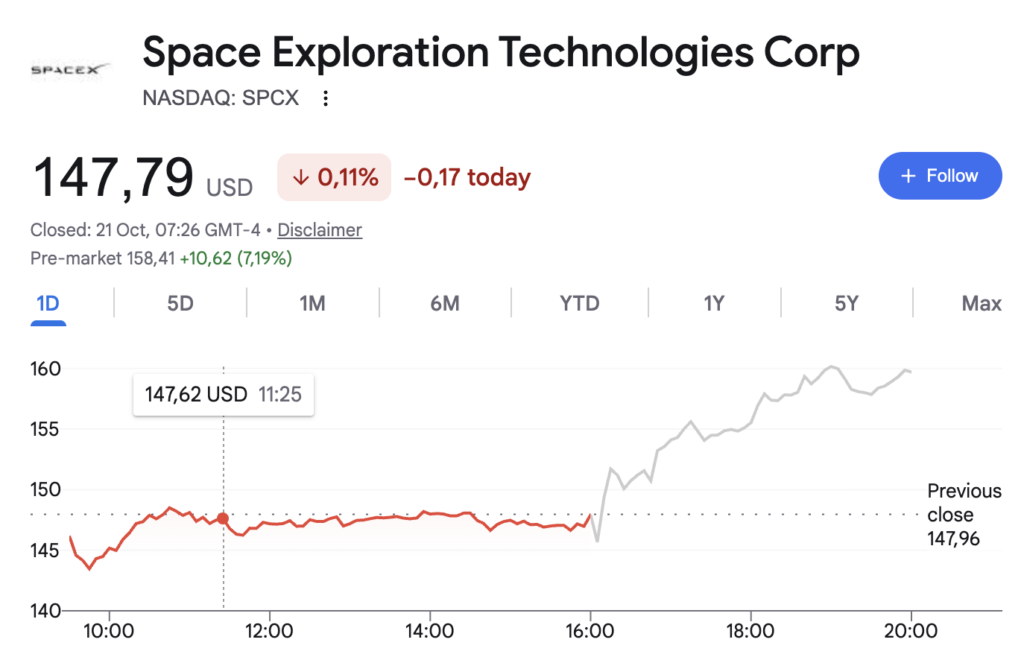
1. Why Is SpaceX Stock Moving in Premarket Trading?
Premarket trading takes place before the regular US stock-market session opens. Prices during this period can react to company announcements, financial results, changes in investor expectations and broader market developments.
SpaceX’s official investor-relations website lists its third-quarter 2026 earnings event for October 20, 2026. The associated earnings materials provide a relevant starting point for examining the company’s recent financial performance.
Official source: SpaceX Q3 2026 Earnings.
However, the publication of financial results and a subsequent share-price increase do not, by themselves, prove a direct causal relationship. To determine whether the results contributed to the market move, investors must compare the reported figures with expectations and examine the timing of the price movement.
My analysis: the key question is whether the market is responding to stronger business performance, expectations of future growth or a combination of factors. Without verified price data and a detailed comparison with market expectations, attributing the entire premarket move to one announcement would be premature.
2. Starlink: A Potentially Important Recurring-Revenue Business
Starlink is SpaceX’s satellite internet service, designed to provide broadband connectivity to customers in a wide range of locations.
Its business model differs from that of a company that earns revenue only when an individual launch is completed. A subscription service can generate recurring revenue from customers over time, potentially making it an important source of commercial activity.
Nevertheless, recurring revenue does not automatically translate into recurring profit. Satellite manufacturing, launch capacity, network maintenance, replacement satellites, ground infrastructure and customer equipment all involve costs.
Several indicators are particularly important when evaluating Starlink:
- Revenue growth: whether demand and sales are increasing.
- Operating margins: whether additional revenue translates into higher profitability.
- Capital expenditure: how much investment is required to expand and maintain the network.
- Cash generation: whether the business generates cash after operating costs and investment requirements.
A reliable assessment of Starlink’s profitability requires examining SpaceX’s published financial disclosures, including any segment-level information available. Company-wide results should not be treated as a direct measure of Starlink’s individual performance.
My view: Starlink’s recurring-service model could be strategically valuable, but its financial contribution should be assessed using disclosed financial evidence rather than assumptions about subscriber numbers or network size.
Official source: Starlink.
3. Falcon 9 Reusability: An Operational Advantage With Financial Trade-Offs
SpaceX’s Falcon 9 programme uses reusable first-stage boosters on missions where recovery is planned. The company’s official mission pages document booster histories and repeated flights.
Reusability can potentially reduce the need to manufacture a new first stage for every launch. When a booster can be flown repeatedly at an acceptable refurbishment cost, certain manufacturing expenses can be spread across multiple missions.
However, reusability does not make a launch cost-free. Recovery, inspection, refurbishment, maintenance, transportation and other operating expenses remain relevant.
My analysis: repeated booster flights demonstrate an established operational capability, but they do not independently establish the exact cost savings or profit margin achieved per launch. Those conclusions require detailed financial and cost information.
For investors, the relevant question is whether reusability improves the economics of the launch business over time, not simply how many times a rocket has flown.
Official source: SpaceX Falcon 9.
4. SpaceX’s Latest Financial Results: What Matters Most?
SpaceX’s official investor-relations website provides an earnings update for the third quarter of 2026, following the company’s scheduled October 20 earnings event.
Official source: SpaceX Q3 2026 Earnings Update.
When analysing the results, investors should focus on four areas.
Revenue growth
Increasing revenue can indicate stronger demand for launch services, connectivity or other commercial activities. However, the composition of that growth matters. Revenue from different business lines may have different cost structures and profitability profiles.
Operating profitability
Revenue growth is not sufficient to establish that a company is becoming more profitable. Operating expenses, depreciation and other costs must also be considered.
Cash flow
Cash generated from operations helps show whether the business can finance its activities. Net income and operating cash flow are different measures and should not be used interchangeably.
Capital expenditure
SpaceX invests in launch systems, satellites, infrastructure and technology development. These investments may support future growth but can also put pressure on near-term free cash flow.
My analysis: the most useful earnings assessment compares revenue growth with profitability and investment requirements. A company can report strong growth while still requiring substantial capital to support its expansion.
The exact contribution of individual business units should not be assumed unless SpaceX provides sufficiently detailed disclosures. Likewise, a precise earnings-growth figure or valuation multiple should only be published after checking the underlying financial documents.
5. Technical Analysis: How to Interpret a Premarket Price Jump
A premarket price increase can indicate a change in trading prices and investor expectations. However, premarket conditions differ from regular-session trading, particularly in terms of liquidity and trading volume.
A rigorous technical assessment should consider four factors.
Price structure and resistance
Compare the premarket price with the previous regular-session close and relevant historical highs. A move above a previous high may indicate a potential breakout, but it does not guarantee that the price will continue rising.
Trading volume and liquidity
Volume helps assess how much trading activity supports a price movement. A large percentage change on limited volume may be less informative than a move supported by substantial trading activity.
Momentum indicators
Indicators such as the Relative Strength Index (RSI) can help describe the strength of recent price movements. They are not reliable standalone predictors of future prices.
The regular-session opening
After a significant premarket move, traders may monitor whether the regular session confirms the initial direction or whether the price reverses. Both outcomes are possible.
My technical conclusion: a premarket rally is a market signal, not proof that a stock is undervalued. Without a verified, timestamped price series, it would be misleading to publish specific support levels, resistance levels, RSI readings or volume figures.
6. Valuation: Does SpaceX’s Performance Justify Market Expectations?
A company’s share price reflects both its current financial performance and expectations about its future.
Investors may assign a higher valuation to a company if they expect stronger revenue, improving margins, new commercial opportunities or greater cash generation. However, a higher share price can also indicate that ambitious growth expectations are already reflected in the valuation.
A meaningful valuation analysis requires the latest published financial statements, a reliable share price and the relevant share-count data.
Depending on the available disclosures, analysts may examine:
- Price-to-earnings ratio, where meaningful earnings data are available.
- Enterprise value relative to operating earnings, where the required figures are disclosed.
- Revenue growth relative to valuation, to assess the expectations embedded in the share price.
- Free cash flow, to evaluate cash generation after capital investment.
These measures are not interchangeable, and no single ratio fully captures the value of a business with multiple activities and substantial investment requirements.
My view: the central valuation question is whether SpaceX’s financial performance and future cash-generating potential justify the valuation investors are assigning to it. That conclusion requires verified financial figures and a clear explanation of the assumptions used.
Even a business with attractive growth prospects can experience a share-price decline if its results fail to meet market expectations.
7. The Main Risks Investors Should Consider
Several risks remain relevant when assessing SpaceX’s commercial prospects and stock-market valuation.
Capital intensity: rockets, satellites, launch facilities and network infrastructure require substantial investment.
Execution risk: launch schedules, development programmes and technical milestones can change.
Competition: commercial launch services and satellite internet operate in competitive markets.
Valuation risk: even a growing company may disappoint shareholders if its stock price already reflects highly optimistic expectations.
Segment-level transparency: if SpaceX does not disclose sufficiently detailed financial information for individual business units, estimating their separate profitability remains difficult.
Market volatility: premarket prices can be sensitive to limited liquidity, changing expectations and broader market movements.
These risks do not establish whether a stock should rise or fall. They identify the uncertainties that should be considered alongside the company’s growth opportunities.
Conclusion: Separate Business Performance From Market Expectations
SpaceX combines launch services, reusable rocket technology and satellite connectivity. Its Falcon 9 programme and Starlink network provide important context for understanding its operations and potential growth opportunities.
The company’s third-quarter 2026 earnings materials provide a relevant financial reference point. A thorough assessment should examine the underlying figures, compare them with market expectations and evaluate the investment required to sustain future growth.
A premarket rally may reflect increased optimism, but it cannot independently establish the company’s fair value or guarantee that the upward movement will continue.
The most useful analysis distinguishes verified company information from market data and editorial interpretation. For investors following SpaceX, the central questions are whether the company can translate operational scale into sustainable cash generation and whether that performance supports the valuation reflected in its share price.
Disclaimer
This article is for informational and educational purposes only. It expresses editorial analysis and does not constitute personalised investment advice, financial advice or a recommendation to buy, sell or hold any security. It does not take account of any reader’s individual financial circumstances or investment objectives. Market prices can fluctuate, and past performance does not guarantee future results.
Company information should be checked against official disclosures, while market prices and technical indicators should be verified using reliable market-data sources.
Related reading
- SpaceX Stock Soars to Its Best Day in Two Months as Q3 Revenue Jumps 161%
- A Starship Launch Every Week in 2027? Musk’s Targets and What They Mean for SpaceX Stock
- Elon Musk Plans to Give Every American Child a SpaceX Share in 2027: A $10.5 Billion Pledge
Anonymous reader poll, just for fun. Not investment advice.
Read next
Get the daily market briefing
The stories that move markets, in your inbox every trading day at 9 a.m. ET. Free, unsubscribe anytime.