

SpaceX has completed a full-duration static fire test of its Super Heavy booster, firing all 33 Raptor engines as the company prepares for the next Starship test flight. The milestone brings Flight 15 one step closer, although additional checks and regulatory approvals remain.
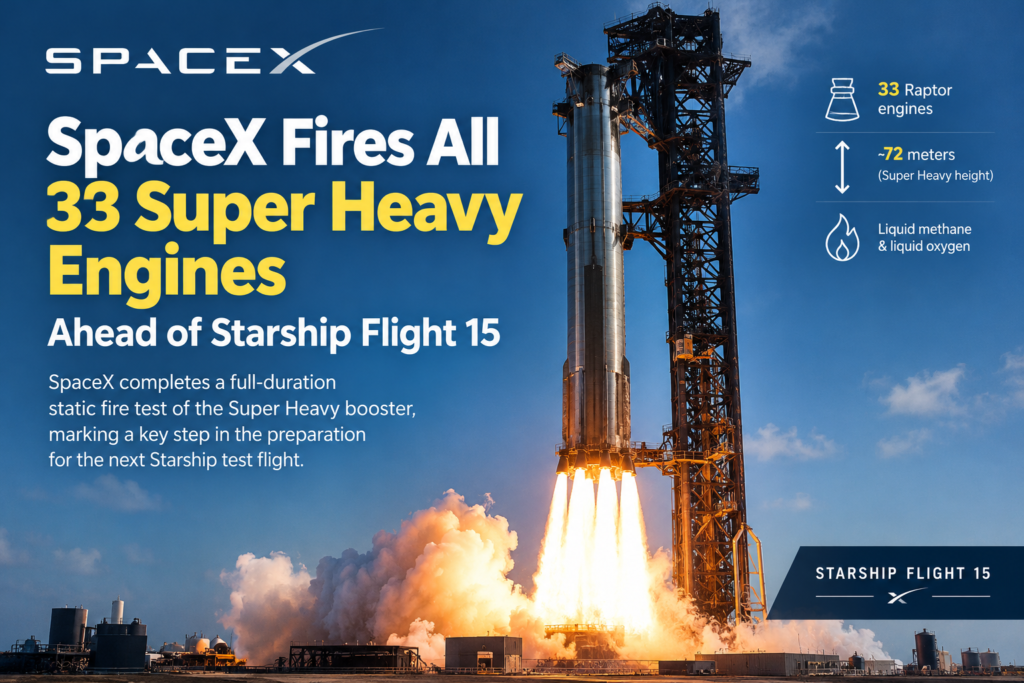
SpaceX Fires All 33 Super Heavy Engines
SpaceX has completed a major ground test of its Starship launch system, successfully carrying out a full-duration static fire of the Super Heavy booster in preparation for Starship Flight 15.
On October 25, 2026, the company announced that all 33 Raptor engines on the booster had been fired while the vehicle remained secured to the launch pad at Starbase, Texas.
The test represents an important step in SpaceX’s preparation for its next integrated Starship flight. By running the booster’s engines together on the ground, engineers can gather critical data on propulsion performance and the vehicle’s systems before attempting another launch.
SpaceX described the event as a “full duration 33-engine static fire” in its announcement on X.
What Is a Static Fire Test?
A static fire is a ground-based test in which a rocket’s engines are ignited while the vehicle is held in place. Unlike an actual launch, the rocket does not lift off.
The test allows engineers to evaluate engine ignition, propulsion-system performance and the interaction between the vehicle and its launch infrastructure under demanding operating conditions.
Super Heavy is the first stage of SpaceX’s Starship launch system. According to the company’s official vehicle specifications, the booster stands approximately 72 meters (236 feet) tall and is powered by 33 Raptor engines that burn liquid methane and liquid oxygen.
The booster is designed to generate enormous thrust during ascent before separating from the Starship upper stage. It is also intended to return to the launch site for recovery and reuse.
Testing all 33 engines together is particularly important because the booster must operate as an integrated system, rather than as a collection of individually tested engines.
However, completing a static fire does not by itself guarantee that every component will perform flawlessly during flight. Engineers must analyze the test data and determine whether any additional inspections or corrective work are necessary.
Why the Test Matters for Starship Flight 15
The static fire is part of SpaceX’s broader preparation for Flight 15, the next integrated test flight of its fully reusable Starship launch system.
The upcoming mission is expected to build on previous flight tests while advancing the company’s efforts to recover and reuse both stages of the vehicle.
SpaceX has outlined an ambitious objective for Flight 15: attempting to bring both the Super Heavy booster and the Starship upper stage back to the launch site for recovery using the launch tower’s mechanical arms.
The company has already demonstrated a successful tower catch of a Super Heavy booster during an earlier Starship test campaign. Recovering the upper stage in the same way would represent a further step toward the fully reusable launch architecture SpaceX is developing.
Such a maneuver would require precise guidance, reliable propulsion, accurate control during descent and coordination with the launch tower.
The recent static fire is therefore a meaningful milestone for the booster. Nevertheless, it should not be interpreted as confirmation that the entire Starship system is ready for launch or that the planned recovery attempt will succeed.
What Comes Next Before Flight 15?
Following the booster test, attention turns to the remaining preparations for the integrated vehicle.
These can include reviewing static-fire data, conducting additional inspections where required, completing preparations for the Starship upper stage and confirming that the launch site and supporting systems are ready.
Regulatory authorization is another important consideration. SpaceX must operate within the applicable launch license and safety requirements before proceeding with the mission.
The timing of Flight 15 will depend on the readiness of the vehicle, the outcome of the remaining checks and the necessary regulatory approvals. Although November has been reported as a target period, readers should distinguish a reported launch window from a firm date officially confirmed by SpaceX.
As a result, the successful booster test reduces one important technical milestone on the preparation schedule, but it does not establish an exact launch date.
Starship and SpaceX’s Reusability Strategy
Starship is central to SpaceX’s long-term plans for lowering the cost of access to space and increasing launch frequency.
The system combines the Super Heavy booster with a large upper stage designed for orbital missions and eventual reuse. Its development is also closely linked to future plans for deploying satellites, transporting cargo and supporting crewed lunar missions.
A key objective is to move beyond recovering only the booster and toward rapidly reusing both stages. If achieved reliably, this approach could reduce the amount of hardware that must be rebuilt or replaced between missions.
That goal remains technically challenging. Each flight provides engineers with additional information about propulsion, thermal protection, structural performance and recovery operations.
Flight 15 could therefore be significant not simply because another Starship launch is planned, but because of the recovery capabilities SpaceX intends to test.
The Bottom Line
SpaceX’s full-duration static fire of all 33 Super Heavy engines marks an important step toward Starship Flight 15.
The test confirms that the booster has completed this major ground-testing milestone, allowing the company to move forward with its review of the vehicle and the remaining launch preparations.
The next key developments to watch are the readiness of the Starship upper stage, the completion of any remaining preflight checks and confirmation of the launch schedule.
For SpaceX, the broader objective remains clear: develop a launch system capable of recovering and reusing both stages. Flight 15 could provide another important test of that ambition, but the outcome will depend on the performance of the complete vehicle during flight.
This article is for informational purposes only and is based on publicly available information. Launch schedules and mission objectives may change as testing and regulatory reviews progress.
Anonymous reader poll, just for fun. Not investment advice.
Read next



Get the daily market briefing
The stories that move markets, in your inbox every trading day at 9 a.m. ET. Free, unsubscribe anytime.