
October 28, 2026 | TickerRoast Markets Analysis
Alphabet’s third quarter delivered 25% revenue growth and a cloud business that more than doubled. It also delivered a second straight quarter of negative free cash flow, as spending on data centers and chips ran ahead of the cash the business generates. Both facts matter, and I think the second will shape the debate more than the first.
A Half-Trillion-Dollar Run Rate
According to the earnings release Alphabet filed with the SEC after the close on October 28, revenue for the quarter ended September 30 rose 25% to $127.6 billion from $102.3 billion a year earlier, the 13th consecutive quarter of double-digit growth. Operating income rose 30% to $40.6 billion, for an operating margin of 31.8%. Chief Executive Sundar Pichai said the company is “now on a half-trillion dollar revenue run rate.”
The core advertising business held up better than many skeptics of AI search expected. Google Search and other revenue rose 12% to $63.4 billion, and the company says year-over-year growth in search queries is the highest it has been in five years. YouTube ads grew 9% to $11.2 billion, while the Google Network business was nearly flat at $7.5 billion. Subscriptions, platforms and devices rose 11% to $14.3 billion. In total, Google Services revenue rose 11% to $96.3 billion and its operating income reached $39.2 billion.
| Line | Q3 2025 | Q3 2026 | Change |
|---|---|---|---|
| Total revenue | $102.3B | $127.6B | +25% |
| Google Search & other | $56.6B | $63.4B | +12% |
| YouTube ads | $10.3B | $11.2B | +9% |
| Google Cloud revenue | $15.2B | $30.7B | +103% |
| Google Cloud operating income | $3.6B | $11.1B | +209% |
| Capital expenditures | $24.0B | $51.4B | +114% |
| Diluted EPS | $2.87 | $2.12 | -26% |
Google Cloud Becomes a Second Engine
The standout was Google Cloud. Revenue rose 103% to $30.7 billion, which the company attributes to enterprise AI infrastructure and AI solutions, core Google Cloud Platform services, and says sales of TPU systems, built around its in-house AI chips, were a meaningful contributor. Operating income in the segment rose to $11.1 billion from $3.6 billion, lifting the segment margin to roughly 36% from about 24% a year earlier by my calculation.
That changes how I think about the company. A year ago Cloud was about 15% of revenue. It is now about 24%, and it is growing roughly nine times faster than Services. Pichai also said Alphabet’s first-party model APIs are processing nearly 32 billion tokens per minute, more than four times the level of a year ago, and that the Gemini app has reached one billion users.
The Bill for the Build-Out
The cash flow statement tells the other side of the story. Purchases of property and equipment reached $51.4 billion in the quarter, more than double the $24.0 billion of a year earlier. Operating cash flow actually fell, to $42.3 billion from $48.4 billion. The result is free cash flow, as Alphabet itself defines it, of minus $9.1 billion, after minus $5.9 billion in the second quarter. Over the trailing twelve months, free cash flow was $19.7 billion on capital spending of $159.8 billion.
The financing choices follow from that. Alphabet bought back no stock in the third quarter, after $39.8 billion of repurchases in the second. It issued 12 million Class A shares and 24 million Class C shares through an at-the-market program for net proceeds of about $12.4 billion, and it still has $27.6 billion available under that program. It also raised $28.7 billion in senior unsecured notes. Interest expense rose to $967 million from $143 million a year earlier. The quarterly common dividend stays at $0.22 a share.
None of this threatens the balance sheet. Cash, cash equivalents and marketable securities stood at $265.1 billion at the end of September. But a company that spent $39.8 billion on buybacks in the second quarter alone is now selling new shares to fund data centers, and investors who owned it for the capital returns will notice.
Why Earnings Per Share Fell
Diluted EPS fell to $2.12 from $2.87, and net income to $26.2 billion from $35.0 billion. Most of that gap comes from the investment portfolio rather than operations. Alphabet booked an $8.7 billion loss on equity securities this quarter, against a $10.7 billion gain a year earlier. The company says the loss reduced net income by $6.7 billion and EPS by $0.55. The release does not say which holdings drove it. Expenses for shared AI research, reported as Alphabet-level activities, also rose to $7.7 billion from $4.5 billion.
The First Reaction
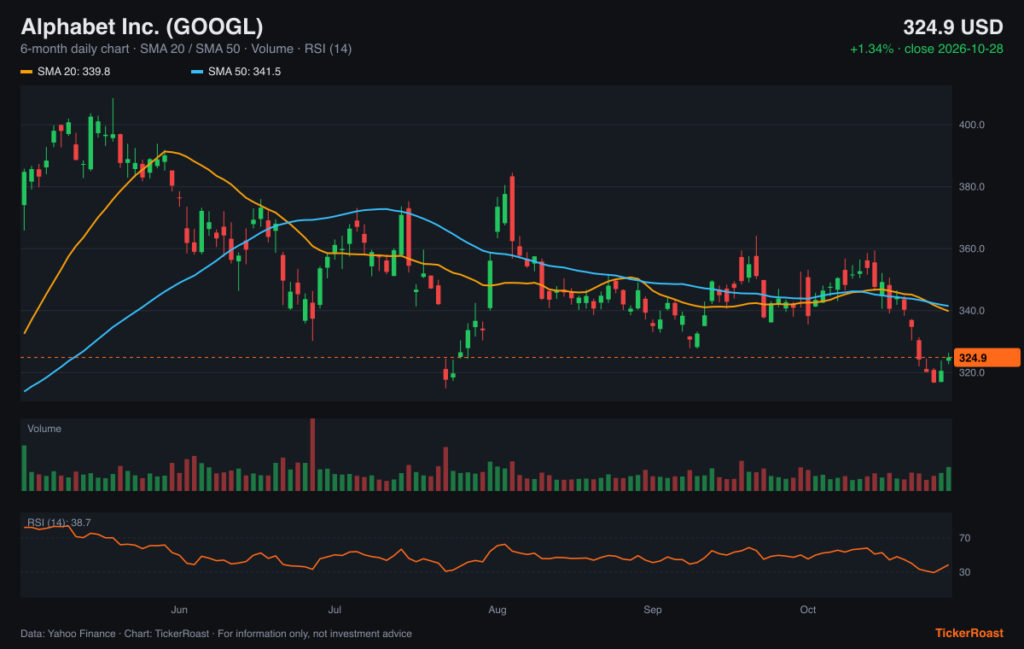
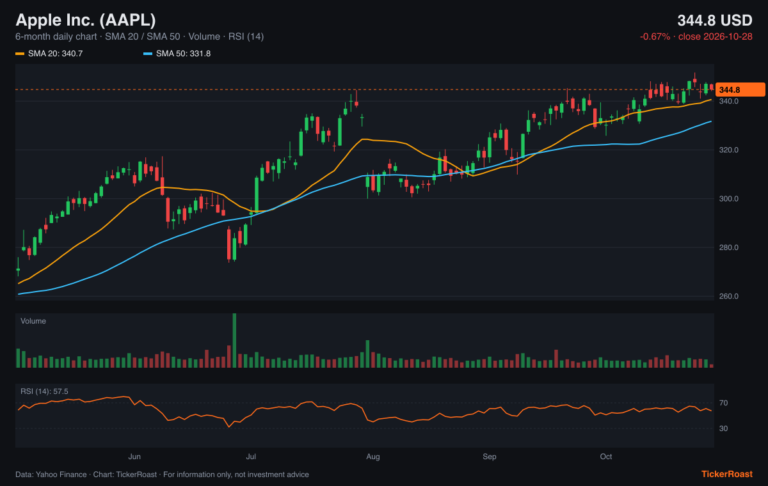
The market did not wait for the call. Class A shares closed the regular session at $324.89, and in the first minutes of after-hours trading they fell to about $300, a drop of roughly 7.7%, according to Yahoo Finance data I checked shortly after the release. After-hours prices are thin and can swing widely before the next open, so I would not read too much into the exact level. The direction is the message: investors are weighing the spending and the dilution at least as heavily as the cloud growth. The six-month chart shows why the stock had little cushion. Alphabet traded around $400 in May and has drifted lower since, and it closed the regular session below both its 20-day and 50-day moving averages, with a 14-day RSI of about 39. An after-hours price near $300 would sit below every close in that six-month window.
The 10-Q and the earnings call will fill in the pieces the release leaves out, chiefly the capital spending outlook for 2027 and the size of the cloud backlog. For the suppliers that reported this morning, from Vertiv to Amphenol, a capex line of $51 billion a quarter is the best news they could have hoped for. For Alphabet’s own shareholders, the question is how long the company can grow cloud revenue at triple digits before the cash flow catches up with the spending.
Sources
- Alphabet announces third quarter 2026 results (Form 8-K, Exhibit 99.1) — SEC / Alphabet
- Alphabet (GOOGL) quote and chart — Yahoo Finance
Market data: Yahoo Finance, close of 2026-10-28. Charts generated by TickerRoast from this data.
Disclaimer: This article is for informational and educational purposes only. It provides general financial and business analysis and does not constitute investment advice, a personal recommendation, a recommendation to buy, sell or hold any security, or an offer to transact in any financial instrument. Information is based on publicly available sources as of October 28, 2026 and market data as of the 2026-10-28 close (Yahoo Finance). Past performance is not a reliable indicator of future results; forecasts are uncertain and actual results may differ materially. Investing in shares involves risk, including the loss of capital. The publisher does not guarantee the accuracy or completeness of the information and accepts no responsibility for investment decisions made on the basis of this article. Readers should consult official company disclosures, conduct their own research and, where appropriate, seek advice from a licensed financial adviser. Any relevant financial interests held by the author or publisher in the securities mentioned are disclosed where applicable. This article was prepared with the assistance of AI tools and is based on the sources listed above.
Anonymous reader poll, just for fun. Not investment advice.
Read next
Get the daily market briefing
The stories that move markets, in your inbox every trading day at 9 a.m. ET. Free, unsubscribe anytime.