
November 3, 2026 | TickerRoast Markets Analysis
Pfizer beat third-quarter expectations and raised its full-year outlook on Tuesday, with Eliquis and a group of newer oncology and cardiology drugs more than offsetting another steep decline in COVID-19 products. The shares were flat before the open, a muted reaction that says a lot about what investors now want from the company.
A Flat Top Line Hides Two Very Different Businesses
Pfizer’s third-quarter release shows revenue of $16.58 billion, essentially unchanged from $16.65 billion a year earlier, and adjusted diluted EPS of $0.87, also flat. On a reported basis, EPS fell 9% to $0.56. According to CNBC, analysts polled by LSEG expected adjusted earnings of $0.73 per share on revenue of $15.87 billion, so the beat was substantial on both lines.
The headline number is the least interesting part. Excluding Comirnaty and Paxlovid, Pfizer says revenue grew 7% operationally, and its launched and acquired products grew 32%. In other words, the core business is growing at a respectable pace while the pandemic franchise keeps shrinking underneath it.
Eliquis and Oncology Do the Heavy Lifting
The growth came from a handful of products. Eliquis revenue rose 25% operationally to $2.52 billion, which Pfizer attributes mainly to a higher net price in the U.S. from lower rebates and favorable channel mix, along with higher global demand. Padcev, the bladder cancer drug, grew 55%, the Vyndaqel family 12%, the migraine treatment Nurtec 33%, and the lung cancer drug Lorbrena 43%, all on an operational basis.
| Product | Q3 2026 revenue | Operational change |
|---|---|---|
| Eliquis | $2.52B | +25% |
| Prevnar family | $1.56B | -10% |
| Comirnaty | $808M | -29% |
| Nurtec ODT/Vydura | $547M | +33% |
| Paxlovid | $449M | -63% |
| Total company | $16.58B | Flat |
The declines were concentrated where I would expect them. Paxlovid fell 63% to $449 million on lower COVID-19 infections, Comirnaty dropped 29% to $808 million on narrower U.S. vaccine recommendations and lower contractual deliveries abroad, and the Prevnar pneumococcal vaccine family fell 10% to $1.56 billion, which Pfizer attributes to lower U.S. vaccination rates and share erosion in the adult indication. The Prevnar decline is the one I watch most closely, because unlike the COVID products it was supposed to be a stable franchise.
Guidance Goes Up, Despite a $650 Million Charge
The raise is the clearest signal in the report. Pfizer now expects 2026 revenue of $62.0 billion to $64.0 billion, up from $60.5 billion to $62.5 billion, a $1.5 billion increase at the midpoint. It also raised and narrowed its adjusted EPS range to $2.95 to $3.05 from $2.80 to $3.00, even though the new range absorbs a one-time $650 million acquired R&D charge tied to its in-licensing agreement with China’s Innovent Biologics, which Pfizer says reduces EPS by about $0.10.
Spending is moving in the direction of the pipeline. Reported R&D expenses rose 18% to $3.02 billion in the quarter, driven, according to the company, by oncology and obesity candidates. Pfizer also raised its adjusted R&D guidance for the year to $10.8 billion to $11.8 billion. CEO Albert Bourla said in the release that the obesity program continued to advance, without new data in the report itself.
The cost lines were mostly well behaved. Cost of sales fell to 24.3% of revenue from 25.0% a year earlier, and selling, informational and administrative expenses rose only 3% to $3.28 billion. The bigger swing sits below the operating line: over the first nine months, reported net income fell 40% to $5.68 billion, largely because other deductions rose to $4.87 billion from $2.21 billion in the same period of 2025. Adjusted income, which strips out those items, was down a more modest 6% to $13.72 billion. For the year to date, total revenue is up 2% to $46.07 billion, which is the baseline against which the new $62 billion to $64 billion target should be read: it implies fourth-quarter revenue of roughly $16 billion to $18 billion, compared with $16.6 billion in the quarter just reported.
Why the Stock Barely Moved
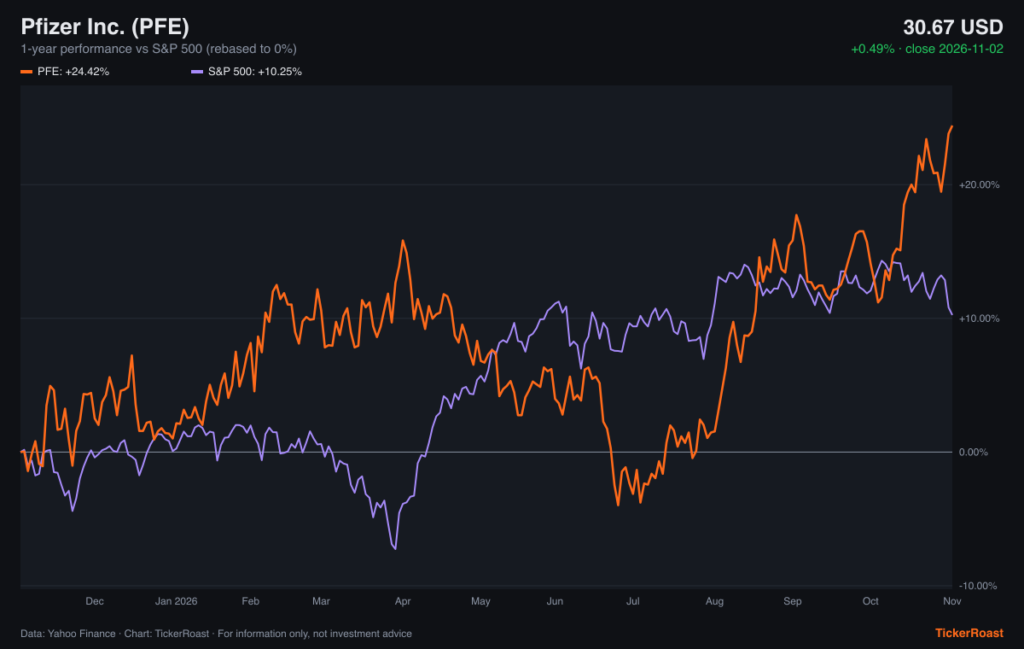
The chart compares Pfizer’s performance over the last year with the S&P 500. Pfizer closed Monday at $30.67, up about 24% over twelve months against roughly 10% for the index, with most of that outperformance coming since August. In other words, the stock went into the report near its best level of the year, which helps explain why CNBC reported the shares flat in premarket trading after a beat-and-raise quarter: a good part of the improvement was already priced in.
Beyond positioning, I think the muted move reflects two things. First, much of the upside came from Eliquis pricing, which investors know is temporary: the drug faces generic entry and price erosion in some international markets already, and the U.S. pricing environment is shifting. Pfizer’s own risk factors mention its voluntary agreements with the U.S. government to lower drug costs and to list certain products on the TrumpRx.gov platform, as well as Most-Favored-Nation pricing policies. Second, the balance sheet still limits flexibility. Pfizer says it has completed no share repurchases in 2026, that its guidance assumes none, and that it plans to keep de-levering.
The repurchase question is worth dwelling on. Pfizer still has $3.3 billion of authorization left as of November 3, but the release describes buybacks as something it may resume only after de-levering, and only in the future. That leaves the dividend as the main way the company returns cash, and it explains why investors react more to guidance on cash generation than to a single quarter’s earnings beat.
A New CFO and a Pipeline Still to Prove
The release also confirms that Cecile Guegan became chief financial officer on November 1. In the first nine months of the year, Pfizer invested $8.3 billion in internal R&D and paid $7.3 billion in dividends, or $1.29 per share. For a stock that has largely become an income vehicle, keeping that dividend secure while funding obesity and oncology trials is the balancing act Guegan inherits.
The 32% growth in launched and acquired products shows that the post-COVID portfolio is working. What the market still needs is evidence that the next wave, particularly in obesity, can matter at Pfizer’s scale. Management will take questions on that during its 10:00 a.m. Eastern call, and I expect pipeline timelines to draw more attention than the beat itself.
Sources
- Pfizer Reports Strong Third-Quarter 2026 Results and Raises 2026 Guidance (Form 8-K, Exhibit 99) — Pfizer / SEC
- Stocks making the biggest moves premarket: Pfizer, Apple, Palantir, Zebra Technologies & more — CNBC
Market data: Yahoo Finance, close of 2026-11-02. Charts generated by TickerRoast from this data.
Disclaimer: This article is for informational and educational purposes only. It provides general financial and business analysis and does not constitute investment advice, a personal recommendation, a recommendation to buy, sell or hold any security, or an offer to transact in any financial instrument. Information is based on publicly available sources as of November 3, 2026 and market data as of the 2026-11-02 close (Yahoo Finance). Past performance is not a reliable indicator of future results; forecasts are uncertain and actual results may differ materially. Investing in shares involves risk, including the loss of capital. The publisher does not guarantee the accuracy or completeness of the information and accepts no responsibility for investment decisions made on the basis of this article. Readers should consult official company disclosures, conduct their own research and, where appropriate, seek advice from a licensed financial adviser. Any relevant financial interests held by the author or publisher in the securities mentioned are disclosed where applicable. This article was prepared with the assistance of AI tools and is based on the sources listed above.
Anonymous reader poll, just for fun. Not investment advice.
Read next

Get the daily market briefing
The stories that move markets, in your inbox every trading day at 9 a.m. ET. Free, unsubscribe anytime.