

November 3, 2026 | TickerRoast Markets Analysis
Apple delivered a record September quarter in John Ternus’ first report as CEO, with revenue up 12% to $114.5 billion and iPhone sales up more than 17%. But the company guided gross margin to 45% to 46% for the holiday quarter as memory costs climb, and the stock was about 4% lower before Tuesday’s open.
A Beat on Every Headline Number
On paper, the quarter was clean. Apple’s earnings release shows revenue of $114.48 billion for the three months ended September 26, up from $102.47 billion a year earlier, and diluted earnings per share of $2.10, up 14%. According to CNBC, analysts polled by LSEG expected $1.99 per share on revenue of $113.39 billion. Net income rose to $30.7 billion from $27.5 billion.
Two details deserve a footnote. First, Apple says the 47.9% gross margin includes a favorable impact of about one percentage point from tariff refunds, and EPS includes a $0.05 benefit from the same source. Without those refunds, the quarter’s EPS would have been closer to $2.05, still above consensus but by a narrower margin. Second, the fiscal year as a whole set a record: revenue reached $478.8 billion, up from $416.2 billion, and full-year diluted EPS rose to $8.98 from $7.46.
The iPhone Carried the Quarter, the iPad Did Not
The product breakdown tells a two-speed story. iPhone revenue rose to $57.58 billion from $49.03 billion, an increase of about 17%, and the Mac grew about 24% to $10.79 billion, both ahead of the estimates CNBC cites. The iPad went the other way, falling about 10% to $6.23 billion against an expected $6.7 billion, and Wearables, Home and Accessories declined about 8% to $8.30 billion.
| Category | Q4 FY2026 | Q4 FY2025 | Change |
|---|---|---|---|
| iPhone | $57.58B | $49.03B | +17% |
| Mac | $10.79B | $8.73B | +24% |
| iPad | $6.23B | $6.95B | -10% |
| Wearables, Home and Accessories | $8.30B | $9.01B | -8% |
| Services | $31.57B | $28.75B | +10% |
| Total | $114.48B | $102.47B | +12% |
CNBC adds that the iPhone figure included only eight days of iPhone 18 Pro sales, and that the new iPhone Duo did not reach stores until after the quarter closed. Geographically, Greater China was a standout in the release, with sales up about 21% to $17.54 billion. Services, Apple’s most profitable line, grew just under 10% to $31.57 billion, which CNBC describes as the slowest services growth since 2022.
Memory Costs Push the Margin Guide Lower
The guidance is where the stock lost its footing. On the call, CFO Kevan Parekh said December-quarter revenue should grow 7% to 10%, ahead of the 6.1% analysts expected according to LSEG, but that gross margin would be between 45% and 46%, below both the 47.9% just reported and the 46.3% consensus, CNBC reports. Parekh also guided services growth to 8% to 9%, another step down. Bank of America, in a note quoted by CNBC, translated the revenue guide into $154 billion to $158 billion.
The reason is the global memory crunch. Apple said memory costs were higher this quarter than in the June period, and CNBC reports that management pointed to memory, together with the cost of rolling out Siri AI, as the main pressure on profitability. Memory shortages are also expected to limit Mac and iPad supply. The balance sheet shows how Apple has been bracing for this: inventories climbed to $14.5 billion at the end of September from $5.7 billion a year earlier, a sign that the company has been securing components ahead of the holiday ramp.
I think the market’s reaction is less about one quarter’s margin than about the direction of travel. Apple raised prices across its lineup in June, including $100 on iPhones, according to CNBC, and Ternus said the company did so reluctantly to offset component costs. If memory prices keep climbing, Apple must choose between another round of price increases and accepting a lower margin, and neither choice is free.
Shares Give Back Part of a Strong Year
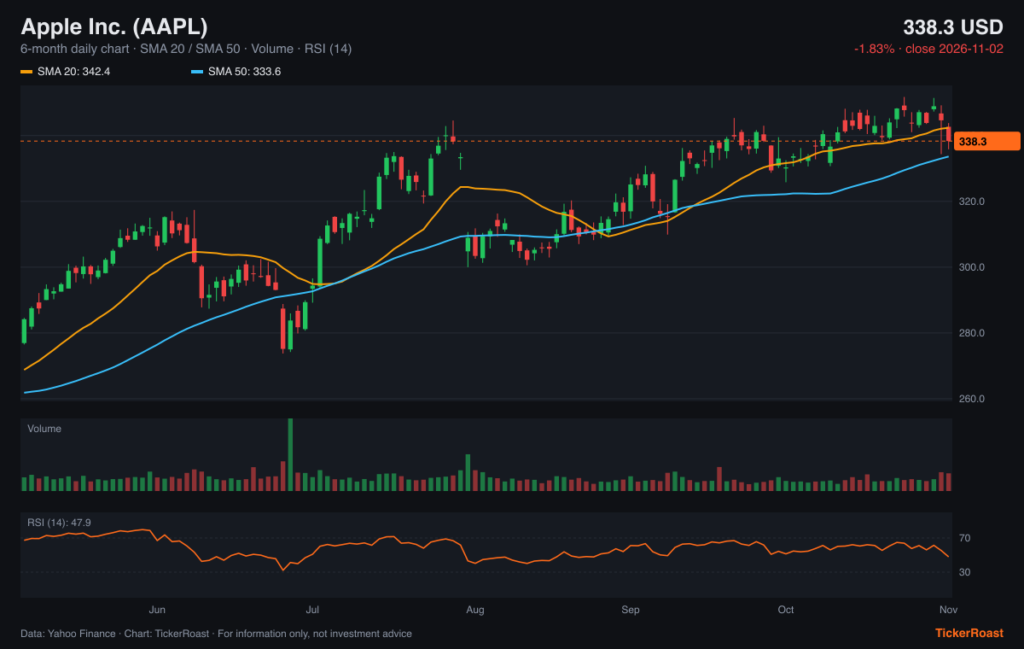
The chart shows Apple over the past six months with its moving averages, volume and RSI. The stock closed Monday at $338.32, down 1.83% ahead of the report and just below its 20-day average near $342, after hovering close to $350 in late October. A 4% decline at the open would take it to roughly $325, below its 50-day average near $334, which has supported the uptrend since early September. The RSI was around 48 at Monday’s close, a neutral reading that leaves room for further selling. Even so, CNBC notes that Apple shares are up about 24% in 2026, ahead of most large technology names, which is precisely why a margin disappointment hurts: the valuation left little room for error.
Wall Street Splits on Margins Versus Demand
Analysts quoted by CNBC were divided along predictable lines. Goldman Sachs said it came away with more confidence in the iPhone refresh cycle, including the iPhone Duo and the foldable form factor, while warning that memory cost inflation will be a multi-quarter overhang. Evercore ISI said the debate is shifting toward margins and earnings power as memory costs rise and services growth moderates. Barclays, the most negative of the group, said it is most concerned about services, pointing to regulatory pressure in the EU and the U.S. over link-out transactions in the App Store.
Morgan Stanley summed up the standoff well: bulls will point to the December-quarter revenue upside and strong free cash flow, bears to the services deceleration and memory headwinds. I would add one number to the bull side of the ledger. Apple generated $145.1 billion of operating cash flow in fiscal 2026 and spent $86.4 billion on buybacks, according to its cash flow statement. That capacity does not disappear because gross margin slips by a point or two.
What the Holiday Quarter Has to Prove
The December quarter will be the first full period with the iPhone 18 Pro, the iPhone Duo and the new touch-screen Macs on sale, and the first with the full cost of Siri AI flowing through. Apple will pay a dividend of $0.27 per share on November 16, according to its release. The real test comes in late January, when investors will see whether the 7% to 10% revenue growth arrived and whether the margin landed at the top or the bottom of the 45% to 46% range. Until memory prices stabilize, I expect that range to matter more to the stock than the unit numbers.
Sources
- Apple reports fourth quarter results (Form 8-K, Exhibit 99.1) — Apple / SEC
- Apple’s stock drops on weak margin forecast in Ternus’ first earnings report — CNBC
- Apple is falling on its latest earnings report. Why most analysts still like the stock — CNBC
- Apple shares slide after weak margin outlook; Palantir slumps 6% after earnings — CNBC
Market data: Yahoo Finance, close of 2026-11-02. Charts generated by TickerRoast from this data.
Disclaimer: This article is for informational and educational purposes only. It provides general financial and business analysis and does not constitute investment advice, a personal recommendation, a recommendation to buy, sell or hold any security, or an offer to transact in any financial instrument. Information is based on publicly available sources as of November 3, 2026 and market data as of the 2026-11-02 close (Yahoo Finance). Past performance is not a reliable indicator of future results; forecasts are uncertain and actual results may differ materially. Investing in shares involves risk, including the loss of capital. The publisher does not guarantee the accuracy or completeness of the information and accepts no responsibility for investment decisions made on the basis of this article. Readers should consult official company disclosures, conduct their own research and, where appropriate, seek advice from a licensed financial adviser. Any relevant financial interests held by the author or publisher in the securities mentioned are disclosed where applicable. This article was prepared with the assistance of AI tools and is based on the sources listed above.
Anonymous reader poll, just for fun. Not investment advice.
Read next

Get the daily market briefing
The stories that move markets, in your inbox every trading day at 9 a.m. ET. Free, unsubscribe anytime.