

October 28, 2026 | TickerRoast Markets Analysis
Visa finished fiscal 2026 with record revenue and a 16% dividend increase. Shares nevertheless slipped in after-hours trading, and the details explain why: growth is still strong, but it is a notch slower than a quarter ago and more of each revenue dollar is being handed back to clients.
The Quarter in Numbers
In its fiscal fourth-quarter release, filed with the SEC on October 27, Visa reported net revenue of $12.1 billion, up 13%. Non-GAAP earnings per share were $3.48, up 17%, while GAAP EPS of $3.19 rose 22%. For the full fiscal year ended September 30, net revenue reached a record $45.9 billion, up 15%, and non-GAAP EPS was $13.27, up 16%.
The GAAP comparison is flattered by last year’s base. Stock Titan notes that the prior-year GAAP figure was depressed by an $899 million litigation provision, which is why GAAP growth outran the non-GAAP figures.
| Metric | Fiscal Q4 2026 | Growth |
|---|---|---|
| Net revenue | $12.1 billion | +13% |
| Non-GAAP EPS | $3.48 | +17% |
| Payments volume (constant dollar) | — | +9% |
| Cross-border volume | — | +14% |
| Processed transactions | 74.2 billion | +10% |
Spending Growth Eased by a Hair
Payments volume grew 9% in constant dollars, which Stock Titan reports is down from 10% in the April-to-June quarter. U.S. card spending rose 9.7% according to Visa’s operational data, against 10.0% in the previous quarter. These are small changes, but Visa trades on the steadiness of this number, and a slight drift lower gives the market something to debate.
Cross-border volume remains the engine. It grew 14% excluding intra-Europe, the same rate as the total. Yet international transaction revenue of $4.1 billion rose only 8% in reported dollars, six points behind cross-border volume, per the same source. Volume is growing faster than the revenue it generates, and the gap deserves attention.
Where the Incentives Went
The release’s revenue lines show a business that is paying more to keep its growth. Service revenue was $5.3 billion, up 14%, data processing revenue was $6.2 billion, up 16%, and other revenue was $1.6 billion, up 40%. Client incentives, the payments Visa makes to banks and merchants to win and retain volume, rose 21% to $5.1 billion. That outpaced the 13% growth in net revenue by eight points. Operating expenses were $4.9 billion, up 7% as reported and 12% on a non-GAAP basis.
None of this is alarming on its own. Incentives that grow faster than revenue are a normal feature of a network renewing large contracts. But combined with expenses growing in the low double digits, they leave less room for margin expansion, which is what a premium valuation usually leans on.
What Management Said About Fiscal 2027
Visa’s earnings materials contain no formal guidance table, but management commentary summarized by Stock Titan points to net revenue growth in the “low-double-digit” range for fiscal 2027, operating expense growth at a low double-digit rate, and EPS growth of “low-double-digit to low-teens” on an adjusted basis. For the October-to-December quarter, net revenue growth is expected at the high end of low-double-digit on a reported basis. A forecast of low-double-digit growth is a step down from the 13% to 15% the company just delivered, which is likely part of what held back the shares.
Chief Executive Ryan McInerney called fiscal 2026 “a milestone year” and said that “trust is the next growth vector for Visa.” The release also confirms the pending $2.4 billion cash acquisition of BioCatch, announced August 3 and expected to close by the end of fiscal second quarter 2027, subject to regulatory approvals.
Capital Return Stays Generous
The board raised the quarterly dividend 16% to $0.780 per Class A share, payable December 1 to holders of record on November 10. In the quarter Visa repurchased about 11 million shares for $4.0 billion, and across the full year it returned $25.6 billion through buybacks and dividends, repurchasing about 61 million shares for $20.5 billion. Stock Titan reports $24.4 billion of authorization remains.
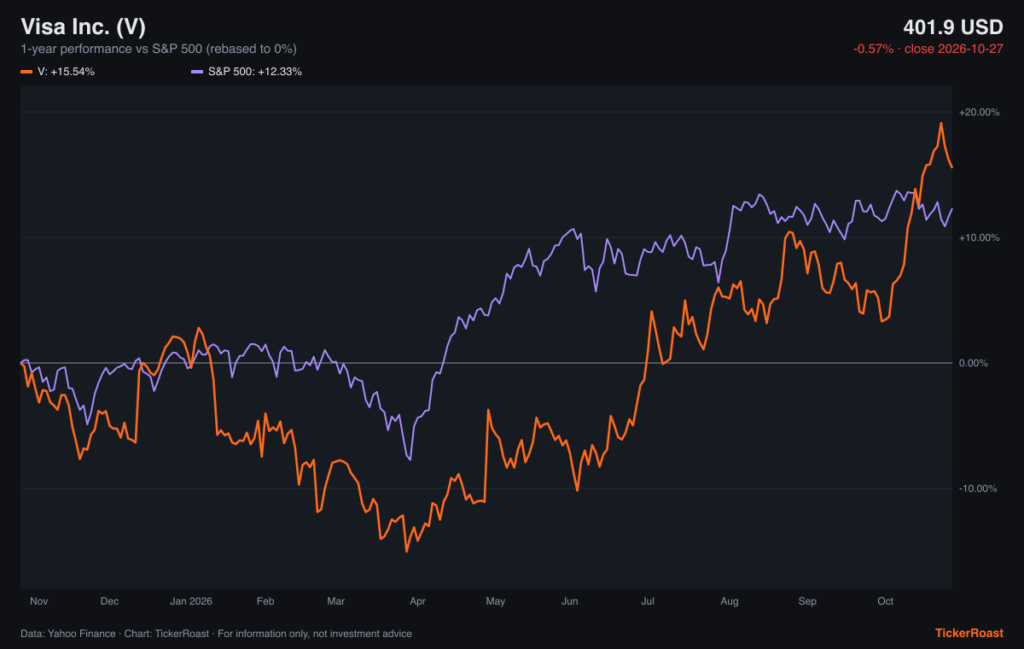
The chart compares Visa’s performance over the past year with the S&P 500. The after-hours slip suggests investors wanted more than a forecast of growth at roughly this year’s pace. Mastercard reports on October 29, and its volume and cross-border figures will show whether Visa’s slight slowdown is a company story or an industry one.
Sources
- Visa Inc. fiscal fourth quarter and full-year 2026 earnings release (8-K) — SEC / Visa
- Visa Earnings: Revenue Up 13% as Card Spending Growth Slowed — Stock Titan
- Earnings call transcript: Visa tops Q4 2026 estimates, shares slip after hours — Investing.com
Market data: Yahoo Finance, close of 2026-10-27. Charts generated by TickerRoast from this data.
Disclaimer: This article is for informational and educational purposes only. It provides general financial and business analysis and does not constitute investment advice, a personal recommendation, a recommendation to buy, sell or hold any security, or an offer to transact in any financial instrument. Information is based on publicly available sources as of October 28, 2026 and market data as of the 2026-10-27 close (Yahoo Finance). Past performance is not a reliable indicator of future results; forecasts are uncertain and actual results may differ materially. Investing in shares involves risk, including the loss of capital. The publisher does not guarantee the accuracy or completeness of the information and accepts no responsibility for investment decisions made on the basis of this article. Readers should consult official company disclosures, conduct their own research and, where appropriate, seek advice from a licensed financial adviser. Any relevant financial interests held by the author or publisher in the securities mentioned are disclosed where applicable. This article was prepared with the assistance of AI tools and is based on the sources listed above.
Anonymous reader poll, just for fun. Not investment advice.
Read next
Get the daily market briefing
The stories that move markets, in your inbox every trading day at 9 a.m. ET. Free, unsubscribe anytime.