

November 3, 2026 | TickerRoast Markets Analysis
Palantir posted the fastest growth in its history as a public company, with revenue up 96% and U.S. commercial sales overtaking government work for the first time. The stock still fell nearly 8% before Tuesday’s open, because the metric that predicts future revenue, new contract bookings, grew far more slowly.
A Quarter Above $2 Billion for the First Time
The reported numbers were exceptional by any standard. Palantir’s third-quarter release shows revenue of $2.313 billion, up 96% from a year earlier and 20% from the second quarter. U.S. revenue rose 119% to $1.937 billion. Within that, U.S. commercial revenue grew 148% to $984 million and U.S. government revenue grew 96% to $953 million, the first time the commercial business has been the larger of the two.
Profitability kept pace. GAAP operating income was $1.085 billion, a 47% margin, and adjusted operating income was $1.427 billion, a 62% margin. GAAP net income came to $1.128 billion and both GAAP and adjusted EPS were $0.44. Adjusted free cash flow was $1.216 billion, and the company ended the quarter with $10.4 billion in cash, cash equivalents and Treasury securities. Palantir puts its Rule of 40 score, which adds revenue growth to the adjusted operating margin, at 158%.
The sequential numbers are just as striking. U.S. commercial revenue grew 29% from the second quarter and U.S. government revenue 18%, which means the acceleration is not a year-over-year base effect. Cash from operations was $1.205 billion, a 52% margin, and adjusted EBITDA reached $1.434 billion. A software company of this size converting more than half of its revenue into operating cash is rare, and it is the main reason the stock has carried such a premium valuation through 2026.
The Bookings Number Behind the Selloff
The problem sits a few lines further down the release. Total contract value closed in the quarter was $2.918 billion, up just 6% year over year, and U.S. commercial TCV was $1.463 billion, up 11%. For a business whose U.S. commercial revenue is growing 148%, bookings growth of 11% is a sharp disconnect, and it is the number the market chose to focus on.
According to CNBC, William Blair flagged the slowdown in U.S. commercial TCV growth in a Tuesday note, while Piper Sandler wrote that investors will want evidence in coming quarters that the 11% figure is a fluke of contract duration rather than something structural. Piper said it believes demand still outstrips supply. I think both readings are plausible: TCV is lumpy and depends heavily on how long the contracts signed in a given quarter run, but a stock priced for sustained hypergrowth does not get the benefit of the doubt.
There is a partial counterweight. U.S. commercial remaining deal value, the value of contracts already signed but not yet recognized, stood at $6.517 billion, up 79% from a year earlier. That figure grew only 4% from the second quarter, though, which points in the same direction as the bookings data: the backlog is still large, but it is filling more slowly.
Guidance Raised Again
Management raised every full-year target. Palantir now expects 2026 revenue of $8.530 billion to $8.534 billion, which it describes as 91% growth, U.S. commercial revenue above $3.559 billion, or at least 143% growth, adjusted operating income of $5.245 billion to $5.249 billion, and adjusted free cash flow of $4.8 billion to $5.0 billion. For the fourth quarter, it guides revenue to $2.649 billion to $2.653 billion, roughly 15% above the third quarter at the midpoint.
The fourth-quarter guide also implies stable profitability. Adjusted operating income of $1.640 billion to $1.644 billion on revenue of about $2.65 billion works out to a margin of roughly 62%, the same level as the third quarter. In other words, management is not buying growth with margin, which makes the bookings slowdown more of a question about demand timing than about the economics of the business. The full 10-Q, filed with the SEC on Tuesday, will give investors the detailed contract and customer data to test that.
| Metric | Q3 2026 | Year-over-year change |
|---|---|---|
| Revenue | $2.313B | +96% |
| U.S. commercial revenue | $984M | +148% |
| U.S. government revenue | $953M | +96% |
| Total contract value | $2.918B | +6% |
| U.S. commercial TCV | $1.463B | +11% |
| Adjusted operating margin | 62% | n/a |
CEO Alex Karp framed the results around what he calls the Sovereign AI movement, arguing in the release that every institution is being pushed into a category of haves or have-nots. The company also highlights 212 deals of at least $1 million closed in the quarter, including 64 worth at least $10 million.
A Momentum Stock Meets a Nervous Tape
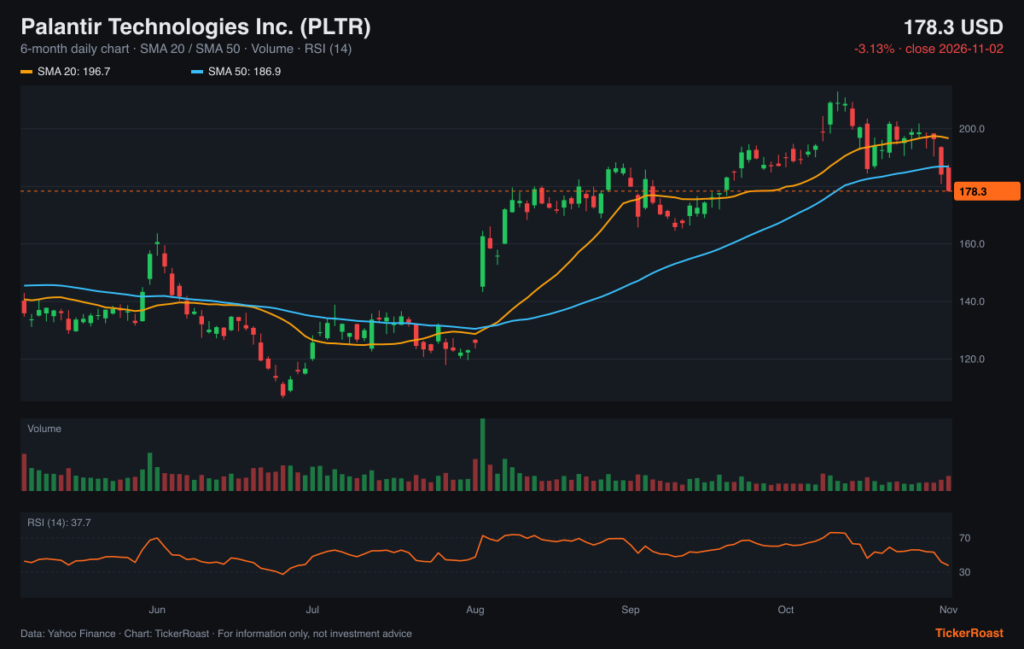
The chart shows Palantir over the past six months with its moving averages, volume and RSI. The stock closed Monday at $178.34, down 3.13% ahead of the report and already below both its 20-day average near $197 and its 50-day average near $187, after peaking above $205 in mid-October. A decline of nearly 8% at the open, as CNBC’s premarket data suggested, would take it to roughly $165, near the September lows, with an RSI that was already down to about 38. Timing matters here: Palantir reported into a market that has spent a week punishing Alphabet, Amazon and Intel for anything that looks like a slowdown or a cash drain.
What Would Change the Debate
I see the report as a test of how much forward visibility investors demand from an AI software company. Revenue growth near 100% and a 62% adjusted margin are not in question. What is in question is whether the bookings slowdown is a temporary shift toward shorter contracts or the first sign that customers are pacing new commitments. The fourth-quarter report will settle a good part of that: if U.S. commercial TCV reaccelerates, the 11% will look like noise; if it stays near that level while revenue keeps compounding, the gap between the two will be the central issue for the stock in 2027.
Sources
- Palantir Reports Q3 2026 Results (Form 8-K, Exhibit 99.1) — Palantir / SEC
- Apple shares slide after weak margin outlook; Palantir slumps 6% after earnings — CNBC
- Stocks making the biggest moves premarket: Pfizer, Apple, Palantir, Zebra Technologies & more — CNBC
Market data: Yahoo Finance, close of 2026-11-02. Charts generated by TickerRoast from this data.
Disclaimer: This article is for informational and educational purposes only. It provides general financial and business analysis and does not constitute investment advice, a personal recommendation, a recommendation to buy, sell or hold any security, or an offer to transact in any financial instrument. Information is based on publicly available sources as of November 3, 2026 and market data as of the 2026-11-02 close (Yahoo Finance). Past performance is not a reliable indicator of future results; forecasts are uncertain and actual results may differ materially. Investing in shares involves risk, including the loss of capital. The publisher does not guarantee the accuracy or completeness of the information and accepts no responsibility for investment decisions made on the basis of this article. Readers should consult official company disclosures, conduct their own research and, where appropriate, seek advice from a licensed financial adviser. Any relevant financial interests held by the author or publisher in the securities mentioned are disclosed where applicable. This article was prepared with the assistance of AI tools and is based on the sources listed above.
Anonymous reader poll, just for fun. Not investment advice.
Read next
 Drax Jumps 8% as Brookfield Plans a £20 Billion, Gigawatt-Scale AI Data Center at Britain’s Biggest Power Station
 SpaceX Surpasses 700 Falcon 9 Flights: How Elon Musk’s Reusable Rocket Revolutionized Spaceflight
 What AI Will Not Say to You: Could Artificial Intelligence Become Humanity’s Most Dangerous Invention?
Get the daily market briefing
The stories that move markets, in your inbox every trading day at 9 a.m. ET. Free, unsubscribe anytime.