

October 27, 2026 | TickerRoast Markets Analysis
Microsoft opened a new chapter in its cost control on Monday: a voluntary exit offer for employees on participating teams, which press reports put at about 60,000 people, roughly a quarter of the workforce. The timing caught my attention. On Wednesday, the company reports its first fiscal quarter, and investors will want to know how it intends to pay for the most expensive infrastructure build-out in its history.
What Microsoft Has Confirmed
In a message to employees published on the official Microsoft blog on October 26, 2026, Chief People Officer Amy Coleman introduced a “time-limited” Voluntary Exit Offer that includes “financial support and career planning resources.” It is open to employees at level 70 and below, the threshold that stops at vice president, on participating teams in the United States, Canada, the United Kingdom and India. Coleman wrote that some organizations are offering it and some are not, and that the program builds on what the company learned from its Voluntary Retirement Program earlier this year.
The blog post gives no headcount target. The figure of about 60,000 eligible employees comes from press reports, which TechCrunch says Microsoft confirmed in substance. Against the roughly 223,000 full-time employees Microsoft reported in its annual report as of June 30, 2026, that would be about 27% of the workforce by my calculation. Reports also indicate that sales, parts of marketing and some engineering and data center teams are excluded, and that the terms resemble Microsoft’s standard severance.
A Voluntary Path, Not a Headline Layoff
A voluntary exit is not a layoff, and the distinction matters for how I read it. Eligibility is not acceptance. According to KUOW, about 30% of eligible employees took the earlier retirement offer, whose terms were more generous, and a Microsoft spokesperson said the company expects lower take-up this time. The same spokesperson said AI is not what is driving the program. The actual reduction could therefore be far smaller than the eligible pool, and Microsoft has not said how many departures it expects.
This is also not the first move of the year. Microsoft ran the retirement program in the spring and announced about 4,800 job cuts in July, concentrated in sales and Xbox. Its fourth-quarter earnings release already listed lower-than-expected costs for the retirement program, partly offset by severance and impairment charges at Xbox, among the items that affected results. A new program of this size could bring another one-time charge in the coming quarters, depending on how many employees accept.
The Spending Behind the Story
The context I keep returning to is capital spending. According to the same release, Microsoft spent $115.9 billion on additions to property and equipment in fiscal 2026, up from $64.6 billion a year earlier, an increase of about 80%, including $35.8 billion in the June quarter alone. Revenue is growing too: $90.0 billion in the fourth quarter, up 18%, with Microsoft Cloud revenue up 27% to $59.3 billion and commercial remaining performance obligations up 84% to $678 billion. But depreciation from that build-out will rise for years, and payroll is the largest cost that management can adjust quickly.
| Microsoft (fiscal 2026, official filings) | Figure |
|---|---|
| Full-time employees (June 30, 2026) | ≈ 223,000 |
| Additions to property and equipment, FY2026 | $115.9B |
| Same, FY2025 | $64.6B |
| Q4 FY2026 revenue | $90.0B (+18%) |
| Commercial remaining performance obligation | $678B (+84%) |
What Wednesday’s Report Needs to Answer
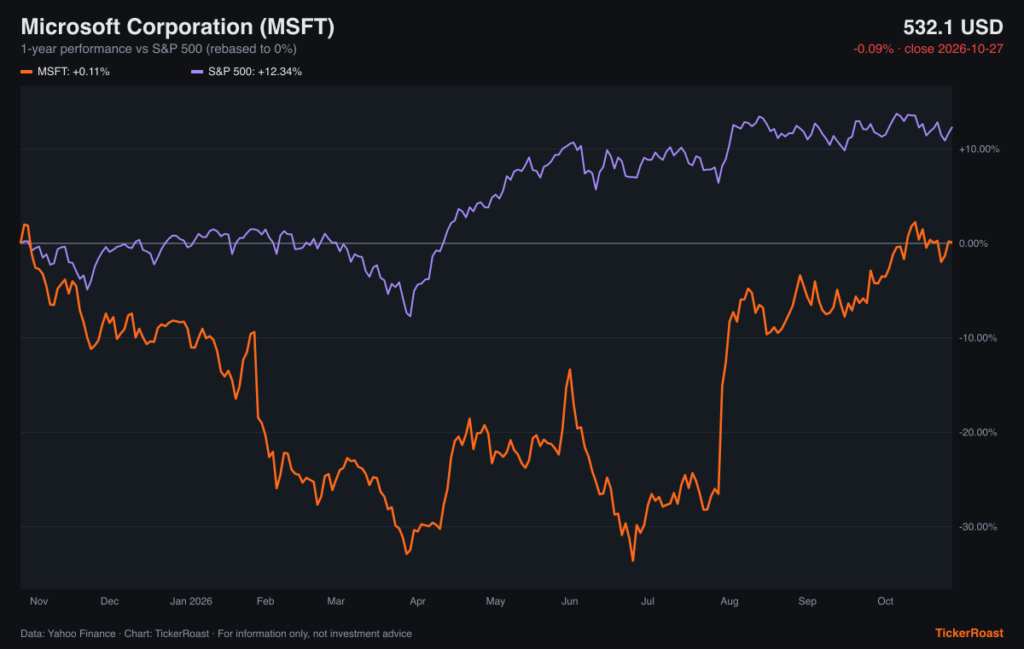
Microsoft will publish its fiscal first-quarter results after the market closes on Wednesday, October 28, 2026, with a webcast at 2:30 p.m. Pacific time, according to the company’s official announcement. The questions I will be listening for are whether management quantifies the cost and expected savings of the exit offer, whether the pace of capital spending changes, and how Azure growth compares with the investment it requires. As the relative chart shows, the stock is roughly flat over the past year while the S&P 500 gained about 12%, even after a sharp rebound from its summer lows; that gap leaves little room for vague answers.
Sources
- Introducing a Voluntary Exit Offer (Amy Coleman) — The Official Microsoft Blog
- Microsoft Form 10-K for fiscal year ended June 30, 2026 — Microsoft / SEC
- Microsoft fourth quarter fiscal 2026 earnings release (Form 8-K, Exhibit 99.1) — Microsoft / SEC
- Microsoft announces quarterly earnings release date — Microsoft (press release)
- Microsoft offers buyouts to around 60,000 employees, reports say — TechCrunch
- Microsoft offers voluntary buyouts to a quarter of its workforce — KUOW
Market data: Yahoo Finance, close of 2026-10-27. Charts generated by TickerRoast from this data.
Disclaimer: This article is for informational and educational purposes only. It provides general financial and business analysis and does not constitute investment advice, a personal recommendation, a recommendation to buy, sell or hold any security, or an offer to transact in any financial instrument. Information is based on publicly available sources as of October 27, 2026 and market data as of the 2026-10-27 close (Yahoo Finance). Past performance is not a reliable indicator of future results; forecasts are uncertain and actual results may differ materially. Investing in shares involves risk, including the loss of capital. The publisher does not guarantee the accuracy or completeness of the information and accepts no responsibility for investment decisions made on the basis of this article. Readers should consult official company disclosures, conduct their own research and, where appropriate, seek advice from a licensed financial adviser. Any relevant financial interests held by the author or publisher in the securities mentioned are disclosed where applicable. This article was prepared with the assistance of AI tools and is based on the sources listed above.
Anonymous reader poll, just for fun. Not investment advice.
Read next
Get the daily market briefing
The stories that move markets, in your inbox every trading day at 9 a.m. ET. Free, unsubscribe anytime.