

October 27, 2026 | TickerRoast Markets Analysis
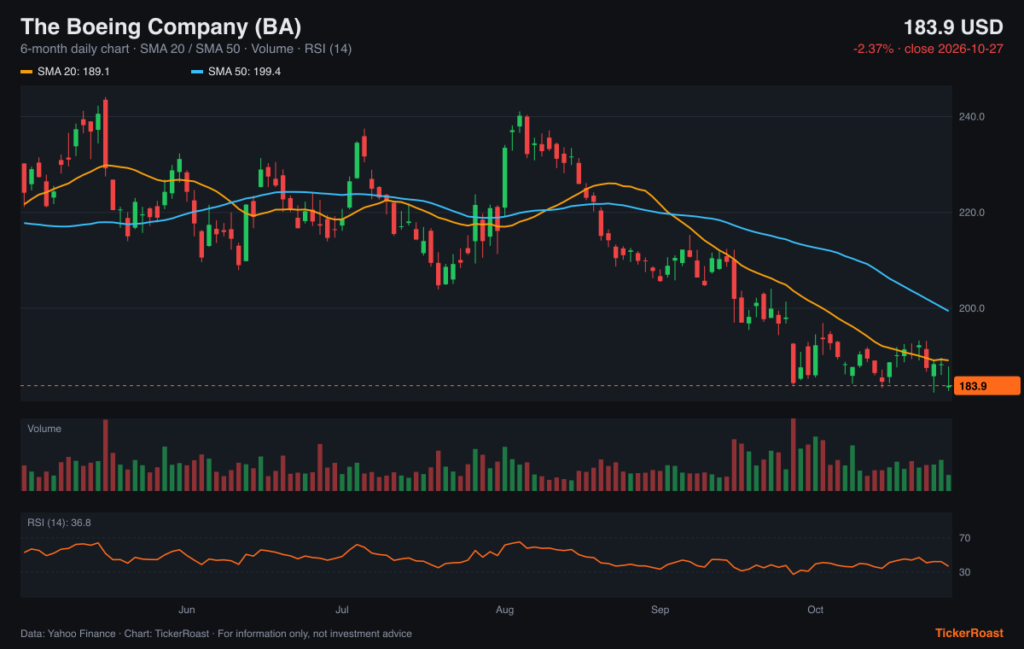
Boeing’s third quarter, reported on October 27, 2026, looks like real progress next to the disaster of a year ago: the net loss fell to $116 million from $5.34 billion, and the company generated $464 million of free cash flow. But when I read past the headline, the commercial airplane business is still losing money on every unit of revenue, and that is what the market chose to focus on.
A Year-Over-Year Comparison That Flatters
According to the earnings release filed with the SEC, revenue rose 4% to $24.2 billion. The GAAP loss came to $0.26 per share against $7.14 a year earlier, a quarter that had absorbed a charge of nearly $5 billion on the 777X program. The core loss, Boeing’s non-GAAP measure, was $0.34 per share. Yahoo Finance put the consensus at a loss of $0.20, so the bottom line came in weaker than analysts had modeled even as revenue landed roughly where they expected.
| Metric | Q3 2026 | Q3 2025 |
|---|---|---|
| Revenue | $24.2B | $23.3B |
| Net loss | $116M | $5,339M |
| Core loss per share | $0.34 | $7.47 |
| Free cash flow | $464M | $238M |
| Commercial deliveries | 161 | 160 |
| Total backlog | $745.4B | — |
Defense and Services Carry the Quarter
The improvement did not come from airplanes. Defense, Space & Security grew revenue 15% to $7.9 billion with a 6.2% operating margin, although that margin includes a $252 million gain on the sale of HRL Laboratories. Without that one-off, I estimate the defense margin would have been closer to 3%. Global Services remains the steady engine, with $5.6 billion of revenue and an 18.3% margin, up from 17.5%.
Commercial Airplanes, by contrast, saw revenue slip 3% to $10.7 billion and posted an operating margin of -6.5%. That is far better than the -48.3% of a year ago, but worse than the -2.7% reported in the second quarter. Boeing attributed the deterioration to a less favorable delivery mix, higher projected costs for future production rate changes and higher supply chain costs. Deliveries tell the mix story: 124 737s and 10 767s, but only 22 787s and 5 777s, the widebodies that carry richer pricing.
Cash Is the Number I Watch Most
Operating cash flow reached $1.5 billion, even after roughly $0.7 billion of payments under the Department of Justice settlement. Over nine months, free cash flow is still negative at $359 million, compared with an outflow of $2.25 billion in the same period of 2025. Management had previously reaffirmed a range of $1 billion to $3 billion of free cash flow for the full year, which implies a heavy fourth quarter. The balance sheet carries $20.7 billion of cash and marketable securities against $45.9 billion of debt, with $10 billion of undrawn credit lines.
The 737 Ramp and the 777X Remain the Real Tests
Boeing says it is progressing toward stabilized 737 production of 47 aircraft per month, the 787 is holding at 8 per month, and the 777-9 remains in certification flight testing with first delivery still targeted for 2027. The FAA amended the type certificate for the 737-7 and certified the 737-10 in October, two approvals that had been pending for years. CEO Kelly Ortberg framed the quarter carefully: “We remain focused on safety and quality as we redouble our efforts on Lean and disciplined execution,” adding, “But we are not done.”
Demand is not the problem. The company booked 300 net commercial orders in the quarter, including from Turkish Airlines, Ethiopian Airlines and Lufthansa, and total backlog hit a record $745.4 billion, with more than 6,300 airplanes at Commercial Airplanes alone. The question I keep coming back to is whether Boeing can convert that backlog at a margin that is positive. As long as rate increases add costs faster than they add deliveries, the commercial margin will stay under pressure, and the fourth-quarter cash figure will show how close the company really is to its annual target.
Sources
- Boeing Reports Third Quarter Results (Form 8-K, Exhibit 99.1) — Boeing / SEC
- Earnings live updates: Boeing stock falls on mixed Q3 turnaround picture — Yahoo Finance
- Boeing narrows third-quarter loss as defense sales rise — CNBC
Market data: Yahoo Finance, close of 2026-10-27. Charts generated by TickerRoast from this data.
Disclaimer: This article is for informational and educational purposes only. It provides general financial and business analysis and does not constitute investment advice, a personal recommendation, a recommendation to buy, sell or hold any security, or an offer to transact in any financial instrument. Information is based on publicly available sources as of October 27, 2026 and market data as of the 2026-10-27 close (Yahoo Finance). Past performance is not a reliable indicator of future results; forecasts are uncertain and actual results may differ materially. Investing in shares involves risk, including the loss of capital. The publisher does not guarantee the accuracy or completeness of the information and accepts no responsibility for investment decisions made on the basis of this article. Readers should consult official company disclosures, conduct their own research and, where appropriate, seek advice from a licensed financial adviser. Any relevant financial interests held by the author or publisher in the securities mentioned are disclosed where applicable. This article was prepared with the assistance of AI tools and is based on the sources listed above.
Anonymous reader poll, just for fun. Not investment advice.
Read next
Get the daily market briefing
The stories that move markets, in your inbox every trading day at 9 a.m. ET. Free, unsubscribe anytime.