

November 4, 2026 | TickerRoast Markets Analysis
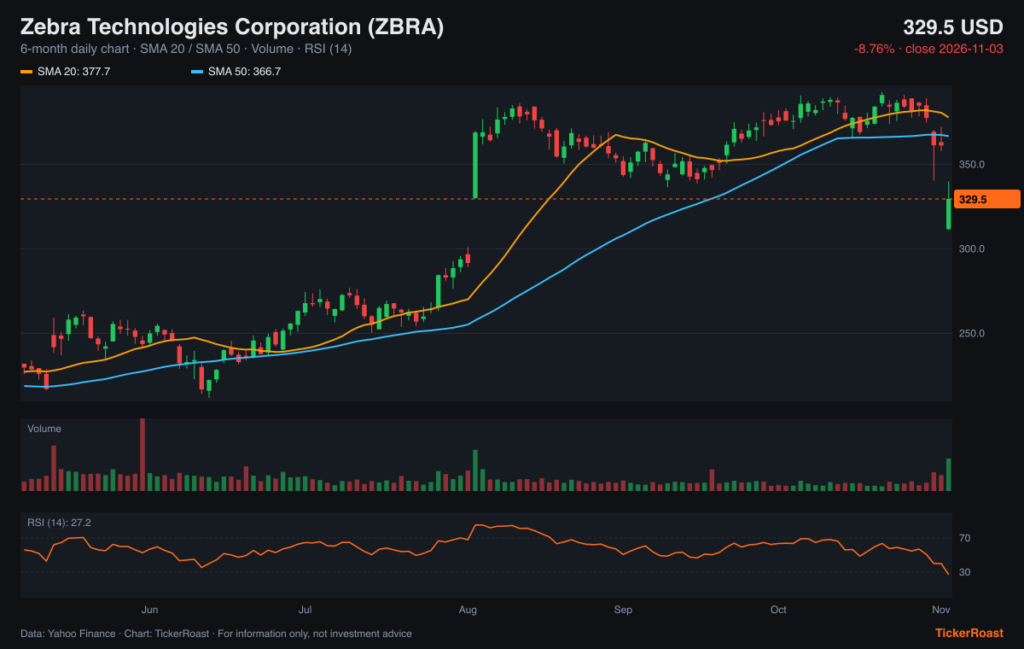
Zebra Technologies (NASDAQ: ZBRA) closed down 8.76% at $329.50 on Tuesday, Nov 3, 2026, from $361.13 the previous session, according to Yahoo Finance price data, on roughly twice the prior day’s volume. The maker of barcode scanners, mobile computers and printers reported third-quarter results before the open. Data as of the Nov 3, 2026 close.
A Record Quarter on the Top Line
Zebra’s third-quarter release, filed with the SEC reads like a good-news story. Net sales rose 22.3% to $1,614 million, with organic growth of 11.3% and the acquired Elo Touch business adding the rest. The Connected Frontline segment grew 15.0% organically, and non-GAAP EPS rose to $4.95 from $3.88. Chief executive Bill Burns called it “another record quarter.”
The company also raised its outlook. It guided fourth-quarter sales growth of 10% to 14% and non-GAAP EPS of $5.00 to $5.40. On the call, according to The Motley Fool’s transcript, chief financial officer Nathan Winters said that translates to full-year sales growth of about 17%, “a two-point increase from our prior outlook.”
The Problem Was a Line Below Sales
The weakness showed up in gross margin, which fell to 45.7% from 48.0% a year earlier; on an adjusted basis it dropped 220 basis points to 46.0%. The release attributes that primarily to increased memory component costs and business mix. Zebra’s devices are full of DRAM and flash, and memory prices have been climbing as AI data centers absorb supply.
The transcript put numbers on it. Winters said the full-year guide reflects mitigation of an “approximately $145 million memory cost headwind, an increase of $25 million from our prior estimate,” which he attributed to higher mobile computing volumes. In the third quarter alone, he said, there was “around $50 million of cost headwind” and the company “realized about $25 million of price.” Put simply, Zebra recovered about half of the extra memory cost through price increases during the quarter.
Why the Stock Fell
My read is that investors focused on the gap between sales and margin. Adjusted EBITDA margin held flat at 21.6%, and the company guided about 22% for the fourth quarter, so the higher sales outlook is not yet translating into higher profitability. Winters said an October price increase amounts to about 15% on mobile computing products and should help Zebra fully mitigate the memory impact “on a dollar-for-dollar basis” going into 2027. Dollar-for-dollar mitigation protects profit dollars, but it does not restore the margin percentage, which is what multiples often key on.
Positioning also mattered. The stock closed at $361.13 on Nov. 2, near the top of a 52-week range of $199.05 to $392.78, according to Yahoo Finance, which left little room for a quarter that was strong but not flawless.
Context: Hardware Makers Caught in the Memory Squeeze
The broader tape gave little cover either way. According to Yahoo Finance index data, the S&P 500 rose 0.36% to 7,568.92 on Election Day, the Nasdaq Composite gained 0.83% as chip stocks rebounded, and the Dow slipped 0.38%, weighed down by Apple, as StockTitan’s session wrap also noted. Zebra was among the S&P 500’s largest decliners, according to Chartmill. The bigger theme is one I expect to hear more of this earnings season: companies that buy memory rather than make it are paying for the AI build-out through their component bills, even when their own end demand is healthy.
What I’ll Be Watching
Burns said on the call that Zebra is not giving a detailed 2027 guide yet but expects growth at the high end of its long-term range, and he described fourth-quarter profitability as a baseline for next year. The test, in my view, is whether the October price increase sticks without denting volumes, and whether memory prices ease as management hopes. If the margin line stabilizes in the first half of 2027, Tuesday’s reaction may look like a positioning reset; if memory keeps climbing, the debate stays alive.
Sources
- Zebra Technologies Announces Third Quarter 2026 Results (Exhibit 99.1, Form 8-K) — Zebra Technologies via SEC EDGAR
- Zebra (ZBRA) Q3 2026 Earnings Call Transcript — The Motley Fool
- Zebra Technologies (ZBRA) historical prices — Yahoo Finance
- S&P 500 Top Movers: Gainers and Losers on Nov. 3, 2026 — Chartmill
- The Stock Market Today, November 3, 2026 — StockTitan
Market data: Yahoo Finance, close of 2026-11-03. Charts generated by TickerRoast from this data.
Disclaimer: This article is for informational and educational purposes only. It provides general financial and business analysis and does not constitute investment advice, a personal recommendation, a recommendation to buy, sell or hold any security, or an offer to transact in any financial instrument. Information is based on publicly available sources as of November 4, 2026 and market data as of the 2026-11-03 close (Yahoo Finance). Past performance is not a reliable indicator of future results; forecasts are uncertain and actual results may differ materially. Investing in shares involves risk, including the loss of capital. The publisher does not guarantee the accuracy or completeness of the information and accepts no responsibility for investment decisions made on the basis of this article. Readers should consult official company disclosures, conduct their own research and, where appropriate, seek advice from a licensed financial adviser. Any relevant financial interests held by the author or publisher in the securities mentioned are disclosed where applicable. This article was prepared with the assistance of AI tools and is based on the sources listed above.
Anonymous reader poll, just for fun. Not investment advice.
Read next
Get the daily market briefing
The stories that move markets, in your inbox every trading day at 9 a.m. ET. Free, unsubscribe anytime.