

November 4, 2026 | TickerRoast Markets Analysis
President Trump was not on the ballot, but Tuesday’s midterms were widely read as a verdict on him, and the verdict was harsh. Democrats have won the House and the Senate, according to NBC News projections. Markets outside the U.S. reacted first: the dollar fell, gold jumped and European stocks rose. Market data as of about 5:20 a.m. ET on Wednesday, Nov. 4, 2026.
A Congress That Changes Hands, a President Who Keeps His Pen
The scale is what stands out. NBC News projects Democrats on course for about 255 House seats, well beyond the 218 needed for a majority, and also projects that they will flip the Senate. By 10:05 a.m. Central European Time, Euronews counted 228 House seats for Democrats against 139 for Republicans, with dozens of races still uncalled, and said Democrats had taken seven Senate seats from Republicans, including in Texas, Ohio, Kansas and Maine. CBS News reported that roughly 75 House races were still undetermined early Wednesday, so the final margins will move.
Trump’s response sets the tone for what follows. According to CBS News, he said “I thought they’d do better,” told Fox News he would accept the results, and described his veto power as “impervious.” According to Euronews, he said “I don’t view it as a hit on me.” CBS also reported that its exit poll put his approval at 38%.
That combination, a hostile Congress facing a president with a veto and broad executive powers, is the starting point for every scenario I outline below. House Democratic leader Hakeem Jeffries listed four priorities, according to NBC News: reversing Medicaid cuts, extending Affordable Care Act credits, restoring congressional authority over tariffs and stopping the war with Iran. Each of them runs straight into that veto.
The First Market Verdict: A Weaker Dollar, Stronger Europe
The global reaction so far is orderly, not panicked. According to Yahoo Finance quotes at about 10:20 GMT, the ICE dollar index was down about 0.5% at 101.32, the euro was up about 0.6% at $1.126 and the Mexican peso had strengthened by about 1.2% against the dollar. The Guardian, in a report carried by AOL, said the dollar index touched a one-month low. IG’s Axel Rudolph told the paper that “the dollar is under pressure as investors reassess the political outlook.”
Equities outside the U.S. were mostly higher. Yahoo Finance data show the Euro Stoxx 50 up about 1.5% and Germany’s DAX up about 1.2% in the morning, Hong Kong’s Hang Seng closing up about 2.3% and the Shanghai Composite up about 1.3%. Japan was the exception: the Nikkei 225 fell about 1.4%, a move The Guardian linked to weakness in AI-related shares across Asia. Gold futures rose about 3% to roughly $4,057 an ounce, and Brent crude slipped about 1.6% to around $102 a barrel.
The sector detail in Europe is more telling than the indexes. According to Euronews, defense stocks fell, with BAE Systems down 5.2% and Rheinmetall down 3.2%, while wind-power names Ørsted and Vestas rose 7.3% and 5.2%. My read is that investors are pricing a U.S. Congress less inclined to fund defense growth and more inclined to support renewables, even if very little of that can become law over a veto.
Wall Street itself is not selling. S&P 500 futures were up about 0.9% and Dow futures about 1.3% at the time of writing, according to Yahoo Finance, after a weaker start overnight. The 10-year Treasury yield was around 4.92% to 4.93%, slightly lower than Tuesday’s close, according to The Guardian and Euronews.
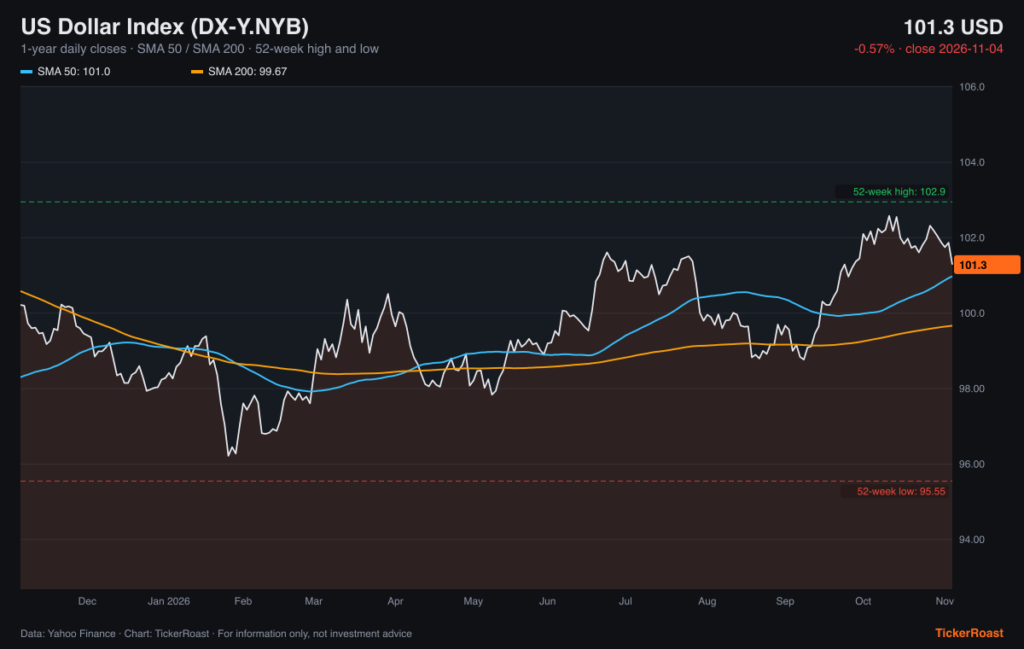
The chart shows the ICE dollar index over the past year with its 50-day and 200-day moving averages and its 52-week range. Wednesday’s decline is modest against that backdrop: at about 101.3, the index remains above both its 50-day average near 101.0 and its 200-day average near 99.7, and in the upper part of its one-year closing range of roughly 96.2 to 102.6, according to Yahoo Finance data. For the rest of the world, the dollar matters more than the S&P 500, because a weaker dollar eases the burden of dollar debt in emerging markets and lowers the cost of imported commodities priced in dollars.
Scenario One: Gridlock, the Base Case
Most of the asset managers surveyed by RankiaPro start from gridlock. Ombretta Signori of Ofi Invest AM said losing the House closes the budget reconciliation route “at least until 2029,” and expects slower growth in defense appropriations rather than cuts. Historically, markets have often been comfortable with divided government because it limits large legislative surprises, and Lombard Odier’s Luca Bindelli noted, according to Euronews, that 10-year yields have tended to fall about 20 to 25 basis points in the three months after midterms.
For the global economy, gridlock is mildly reassuring. It means no large new U.S. fiscal stimulus, which is consistent with a softer dollar, and fewer abrupt policy changes. Ebury’s Diego Barnuevo said a Democratic sweep would be “neutral to mildly positive” for the U.S. fiscal outlook, according to Euronews. The weakness of this scenario is that it assumes the president stays patient, and the most important economic levers do not need Congress.
Scenario Two: Trump Turns to Executive Power on Trade
Tariffs are the scenario that matters most for Europe, Asia and emerging markets. According to Euronews, after the Supreme Court struck down Trump’s emergency tariffs in February, the administration moved them to Section 301, which does not require a vote in Congress. ING’s James Smith wrote, before the vote, that trade “is another power the president can wield unilaterally,” and did not rule out new tariffs aimed at Europe.
Wall Street’s largest bank research desk is already modeling this. According to Fortune, Goldman Sachs economists Alec Phillips and Abhay Duggirala wrote that they expect President Trump to announce new tariff increases after the election, more than offsetting any Democratic attempt to reverse them, with the effective tariff rate rising by a little under two percentage points. If that happens, I would expect the early dollar weakness to fade and export-heavy economies such as Germany, Japan, South Korea and Mexico to give back Wednesday’s gains, because their exposure is to U.S. trade policy, not to the composition of Congress.
Scenario Three: Escalation Abroad
The second executive lever is foreign policy. UBS’s Paul Donovan suggested, according to Fortune, that the president may become more aggressive “once freed from the pursuit of popularity.” Vontobel’s Andrew Jackson told RankiaPro that a tougher U.S. response to Iran after the midterms “represents a significant risk.” Fortune put the cost of the Iran war at $47 billion. For the world economy, this is primarily an oil scenario: Brent near $102 already reflects a conflict premium, and an escalation would push energy costs up for Europe and Asia just as central banks there are fighting inflation, which ING expects to run around 4% in the eurozone, according to Euronews.
Ukraine is the related European question. A Democratic Congress is generally seen as more supportive of aid, but the money still has to clear a veto, and a European Council on Foreign Relations analyst quoted by Euronews advised Europeans to treat earmarked funds “as intent, not commitment.”
Scenario Four: A Fiscal Showdown in December
The nearest hard date is fiscal. According to Fortune, Deutsche Bank noted that federal government funding runs out on December 11, at the end of the 72-day stopgap Trump signed on Sept. 2. With the House changing hands in January, the lame-duck Congress now faces that deadline while both sides reposition. Fortune also cited federal debt of about $40 trillion and a deficit near 6% of GDP, and Ed Yardeni warned, according to Euronews, that “this time could be different” on gridlock and the debt ceiling.
A shutdown would be a short-term drag rather than a crisis, but a prolonged fight over the debt ceiling next year is the scenario in which the world’s benchmark safe asset becomes the source of risk. I would watch Treasury yields and gold for that signal. Gold’s jump above $4,000 an ounce on Wednesday suggests some investors are already buying protection.
Scenario Five: A Slower AI Buildout
The last scenario is specific to this market. According to The Guardian, the dollar’s slide came partly from fears that greater regulation of AI could slow growth. Moomoo ANZ’s Tapas Strickland told the paper that “the pace of the AI infrastructure rollout could slow,” and XTB’s Kathleen Brooks noted that SpaceX was down 5% and Tesla more than 4% in premarket trading. LBP AM’s Sebastian Paris Horvitz told RankiaPro that a Democratic win could dampen momentum in sectors such as artificial intelligence.
This is the channel through which a U.S. election reaches Taiwan, South Korea and Japan most directly, because their chip and equipment makers depend on U.S. data center spending. Congress cannot stop private investment, but hearings, permitting fights and energy legislation can slow it. Monex’s Jesper Koll offered a useful caution, according to The Guardian: AI momentum had turned negative “with or without” a Republican majority, so not every move this week is about politics.
What I’m Watching Next
Three signals will tell me which scenario is gaining ground. The first is whether the White House announces new Section 301 tariffs in the coming weeks, which would favor scenario two and likely reverse the dollar’s slide. The second is the December 11 funding deadline. The third is Friday’s U.S. jobs report, because, as ING’s Francesco Pesole wrote, according to Euronews, the dollar “continues to respond predominantly to the Fed story.” On Wednesday morning, the world’s verdict on Trump’s defeat is a weaker dollar and firmer stocks; whether that holds depends far more on what the president does with the powers he keeps than on the Congress he lost.
Sources
- Democrats win control of the House of Representatives with a vow to combat Trump — NBC News
- Live election results for 2026 midterms — CBS News
- US midterms: What Trump’s defeat means for Europe and global markets — Euronews
- Wall Street is bracing for a fresh wave of tariff hikes, Iran action and potentially a government shutdown after the midterms — Fortune
- US dollar slides after Democrats’ midterm election win as growth fears rise — The Guardian via AOL
- U.S. midterms: what a Democratic Congress means for the markets — RankiaPro
- US Dollar Index (DX-Y.NYB) and global market quotes — Yahoo Finance
Market data: Yahoo Finance, close of 2026-11-04. Charts generated by TickerRoast from this data.
Disclaimer: This article is for informational and educational purposes only. It provides general financial and business analysis and does not constitute investment advice, a personal recommendation, a recommendation to buy, sell or hold any security, or an offer to transact in any financial instrument. Information is based on publicly available sources as of November 4, 2026 and market data as of the 2026-11-04 close (Yahoo Finance). Past performance is not a reliable indicator of future results; forecasts are uncertain and actual results may differ materially. Investing in shares involves risk, including the loss of capital. The publisher does not guarantee the accuracy or completeness of the information and accepts no responsibility for investment decisions made on the basis of this article. Readers should consult official company disclosures, conduct their own research and, where appropriate, seek advice from a licensed financial adviser. Any relevant financial interests held by the author or publisher in the securities mentioned are disclosed where applicable. This article was prepared with the assistance of AI tools and is based on the sources listed above.
Anonymous reader poll, just for fun. Not investment advice.
Read next
Get the daily market briefing
The stories that move markets, in your inbox every trading day at 9 a.m. ET. Free, unsubscribe anytime.