

November 4, 2026 | TickerRoast Markets Analysis
Democrats have won control of the U.S. Senate and appear on course to retake the House after a night of upsets in Republican states, including Texas and Kansas. Stock index futures fell overnight, led by the Nasdaq-100, as investors priced in a Congress more willing to slow the data center buildout, challenge tariffs and investigate the administration for the last two years of President Trump’s term.
Update, 5:30 a.m. ET: The overnight picture has changed. NBC News now projects that Democrats have also won the House, and U.S. index futures have turned higher: according to Yahoo Finance quotes at about 5:20 a.m. ET, S&P 500 futures were up about 0.9%, Nasdaq-100 futures about 0.8% and Dow futures about 1.3%, while the dollar index was down about 0.5% and gold futures were up about 3%. The futures figures below reflect the 12:20 a.m. ET snapshot.
A Senate Map Redrawn in Red States
The scale of the Senate result is what surprised me most. Republicans came into the night with 53 of the chamber’s 100 seats, according to Yahoo News’ live coverage, so Democrats needed a net gain of four. Before midnight on the East Coast, the Associated Press said they would reach at least that number. Sherrod Brown defeated Sen. Jon Husted in Ohio, Roy Cooper flipped North Carolina, Josh Turek beat Rep. Ashley Hinson in Iowa, Democrats also flipped a seat in South Carolina, and Adam Hamilton defeated Sen. Roger Marshall to become Kansas’s first Democratic senator since the Great Depression, according to the AP as reported by Yahoo News.
Texas was the symbolic blow. James Talarico beat Ken Paxton to become the first Democrat to win a Senate seat in the state since 1988, and Gina Hinojosa unseated three-term Gov. Greg Abbott, who conceded around 11 p.m. ET, according to the same live coverage. In Georgia, Sen. Jon Ossoff won reelection. The House was still undecided early Wednesday. Republicans held 218 seats going in against 214 for Democrats, and early returns suggested Democrats were on their way to exceeding the net gain of three they needed, Yahoo News reported.
President Trump distanced himself from the losses. “I wasn’t on the Ballot and if I was, we would have won IN A LANDSLIDE!” he wrote on Truth Social, according to Yahoo News.
Futures Fall, With Tech Leading the Way
Markets did not panic, but the direction was clear. Yahoo Finance quotes at about 12:20 a.m. ET showed Nasdaq-100 futures down about 0.8%, S&P 500 futures down about 0.6%, Dow futures down about 0.35% and Russell 2000 futures down about 0.3% from their prior settlements. That ordering matters. If investors were simply pricing a weaker economy, I would expect small caps to fall the most. Instead the heaviest selling is in the index most exposed to AI infrastructure.
Prediction markets had flagged the outcome. According to StockTitan, which relayed CNBC’s live coverage, Kalshi and Polymarket put the odds of a Democratic House above 90% and of a Democratic Senate above 70% by early Tuesday evening. Part of the result was therefore already in prices. The size of the Senate win, with flips in states such as Kansas and Texas, was less expected.
Why Data Centers Are at the Center of the Reaction
The specific fear in the market is about data centers. CNBC reported on Tuesday evening, as relayed by StockTitan, that a large Democratic Senate majority could weigh on AI-buildout stocks because investors fear more limits on data centers. That concern did not come from nowhere. According to Forbes’ election coverage, data center questions appeared on ballots in at least ten states, including 21 local measures in Ohio alone, 13 of them municipal bans. Yahoo News noted that Abbott faced backlash over data centers in Texas, among other issues.
I would separate two risks here. A Democratic Congress cannot stop private companies from building, and most siting, zoning and power decisions are made by states and utilities. What it can do is hold hearings, slow permitting reform, attach conditions to energy legislation and make the political cost of rising electricity bills more visible. For companies whose valuations assume years of uninterrupted capacity growth, even a slower pace is a meaningful change. For now the reaction in the after-hours market was modest: Nvidia last traded at $206.15 after hours against a $206.69 close, and Constellation Energy at $261.00 against $263.40, according to Yahoo Finance.
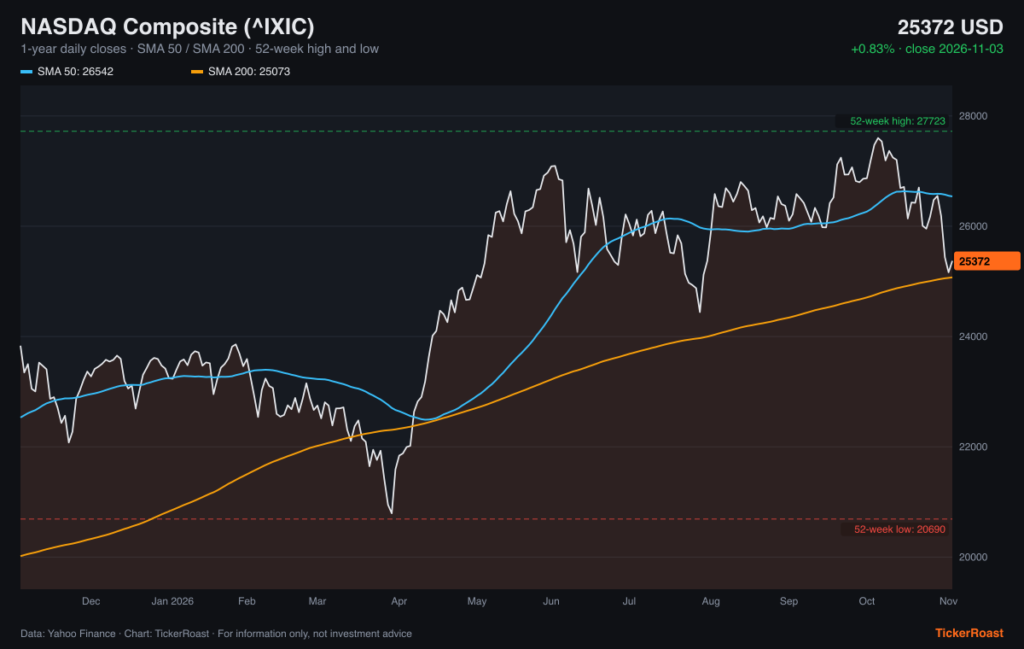
The chart shows the Nasdaq Composite over the past year with its 50-day and 200-day moving averages and its 52-week range. The index closed Tuesday at 25,372.01, about 8% below its October 6 record of 27,599.79 and below its 50-day average near 26,542, but still about 1% above its 200-day average near 25,073. A Nasdaq-100 futures decline of 0.8% would put that long-term average within reach, which is why I see today’s session as a test of whether the October correction becomes something deeper.
Tariffs, the Iran War and Health Care Return to the Agenda
Beyond technology, the policy agenda changes. According to Investopedia, citing The New York Times, a Democratic House could push to end tariffs, to end the war with Iran unless Congress authorizes it, and to reverse Medicaid and Medicare cuts. Each of those has a market angle. Lower tariffs would help importers and retailers, an end to the conflict could pull oil lower from levels where Brent still trades around $104 a barrel, and health care spending is directly relevant to insurers and pharmacy chains, starting with CVS Health, which reports this morning.
The other consequence is gridlock. Majority control gives Democrats the power to block parts of the administration’s agenda, open investigations and reject nominees for the rest of the term, Yahoo News noted. Historically, markets have often been comfortable with divided government because it limits large policy surprises. The difference this time is that the market is already fragile: the Nasdaq-100 entered a correction on Monday, according to CNBC as cited by StockTitan, and Fed Chair Kevin Warsh has warned that higher rates affect “almost everything,” according to Fortune.
What I Am Watching at the Open
The first test is whether the selling in AI infrastructure broadens or stays contained. Strong after-hours reactions to AMD and Arista Networks suggest that company results still matter more than politics on a single day. The second is the House count, since a split Congress and a fully Democratic one carry very different odds for tariff and health care legislation. The third is Friday’s October jobs report, which will shape expectations for the Fed’s December meeting. Until the House is called, I expect sector moves to be driven by headlines rather than by any settled view of the next two years.
Sources
- Midterms 2026 election results and live updates — Yahoo News
- Live Midterm Election Results: Democrats Win Senate — Forbes
- The Stock Market Today, November 3, 2026 — StockTitan
- Markets News, Nov. 3, 2026 — Investopedia via Yahoo Finance
- Nasdaq Composite, index futures and stock quotes — Yahoo Finance
- Fed Chair Kevin Warsh’s warning to AI investors — Fortune
- Democrats win control of the House of Representatives with a vow to combat Trump — NBC News
Market data: Yahoo Finance, close of 2026-11-03. Charts generated by TickerRoast from this data.
Disclaimer: This article is for informational and educational purposes only. It provides general financial and business analysis and does not constitute investment advice, a personal recommendation, a recommendation to buy, sell or hold any security, or an offer to transact in any financial instrument. Information is based on publicly available sources as of November 4, 2026 and market data as of the 2026-11-03 close (Yahoo Finance). Past performance is not a reliable indicator of future results; forecasts are uncertain and actual results may differ materially. Investing in shares involves risk, including the loss of capital. The publisher does not guarantee the accuracy or completeness of the information and accepts no responsibility for investment decisions made on the basis of this article. Readers should consult official company disclosures, conduct their own research and, where appropriate, seek advice from a licensed financial adviser. Any relevant financial interests held by the author or publisher in the securities mentioned are disclosed where applicable. This article was prepared with the assistance of AI tools and is based on the sources listed above.
Anonymous reader poll, just for fun. Not investment advice.
Read next
Get the daily market briefing
The stories that move markets, in your inbox every trading day at 9 a.m. ET. Free, unsubscribe anytime.